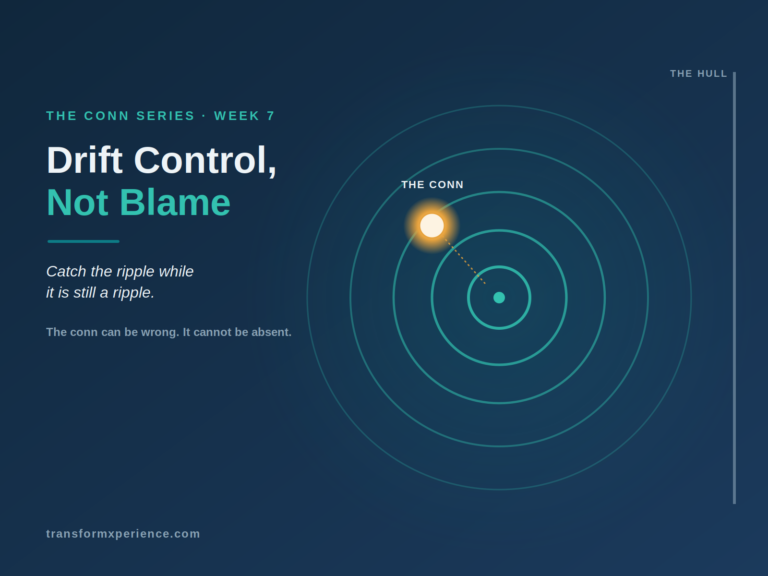
The moment you say one named person is accountable for drift, the room hears a different word. Scapegoat. You can watch it happen. Someone’s shoulders tense, because they assume the
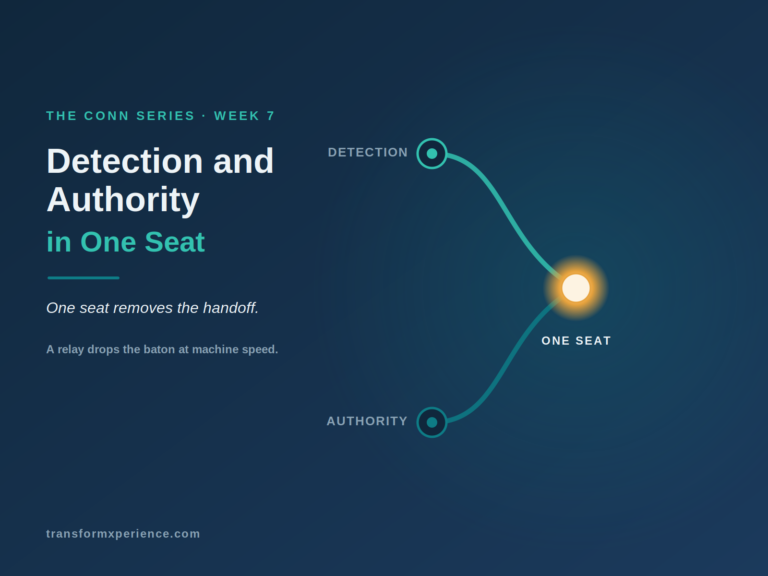
The conn is the named, accountable human who holds detection and authority in one seat, and who runs the operating model against drift. There is one phrase in that definition
If you have followed this series, you have met the conn: the named, accountable seat for governing drift. Drift that is structural, not sloppy. A reach that can break at
A human used to be the throttle. Someone applied the rule, caught the edge case, paused when the numbers looked wrong. That person was slow, and in one respect their
Ask a room of executives who governs the AI, and you get a committee. A steering group, a council, a monthly review with a slide deck and a quorum. That
You named the person on the hook for the AI. Now ask what they are holding. Every serious AI conversation ends in the same place. Someone has to be accountable
The moment you say one named person is accountable for drift, the room hears a different word. Scapegoat. You can watch it happen. Someone’s shoulders tense, because they assume the
The conn is the named, accountable human who holds detection and authority in one seat, and who runs the operating model against drift. There is one phrase in that definition
For three weeks I have described a gap and refused to fill it. Drift that is structural, not sloppy. Drift that belongs to no one, because the seat that should
A human used to be the throttle. Someone applied the rule, caught the edge case, paused when the numbers looked wrong. That person was slow, and their slowness was a
Drift does not spread evenly. It pools at the seams, the handoffs between functions, teams, and vendors, where each side is certain the other one owns it. If drift has
Ask who owns the gap between the system you documented and the system you run. In most organizations the honest answer is no one, and no hire, tool, or program
You cannot govern drift by watching everything. It concentrates in four places, and inspecting those four beats any platform that promises to watch them all. Once leaders accept that the
Every organization operates two systems at once: the one it wrote down and the one it runs. The distance between them is called drift, and most leadership teams are governing
EHR implementations are among the most complex IT projects in any industry. Multiple departments. Thousands of workflows. Clinical staff who have zero patience for systems that slow down patient care.
THE OPERATING MODEL · PART TWO Speed and control are not opposites. By Michelle McKinney, MBA, CSM | CEO and Founder, TransformXperience LLC Reading time: 9 minutes
THE OPERATING MODEL · PART ONE Governance is a continuum, not an event. By Michelle McKinney, MBA, CSM | CEO and Founder, TransformXperience LLC Reading time: 9 minutes Governance is
Your pilot worked in the demo. Then it met your operating model. Why 72% of mid-market AI programs stall before they scale, and the discipline that separates the ones that
By Michelle McKinney, MBA, CSM | CEO and Founder, TransformXperience LLC Over the past several weeks on The Daily Byte, we have been talking about the AI Hangover. The cuts
95% failure rate. 55% regret. 50% rehiring. And the real problem is still sitting untouched in every boardroom that made the call. There is a pattern playing out right now
AI certifications are multiplying. But your organization is not ready because your employees passed an exam. Something significant is happening in the AI space right now. Certification programs are multiplying.
THE OPERATING MODEL · PART THREE Drift is the failure. The conn is the answer. The pairing is what the answer runs on. By Michelle McKinney, MBA, CSM | CEO and
Most executive dashboards are lying to leadership. Not intentionally. Not maliciously. But when your leadership team is reviewing a report that shows green across the board while projects are quietly
There is a moment in every AI implementation where the organization exhales. The model is deployed. The dashboards are live. The executive sponsor sends a congratulatory email. The project team
By Michelle McKinney, CEO and Founder, TransformXperience LLC Reading time: 10 minutes In the previous posts in our Mastering Delivery series, we covered the hidden costs of program misalignment and
By Michelle McKinney, CEO and Founder, TransformXperience LLC Reading time: 9 minutes Here is a truth most PMO leaders learn the hard way. Executive sponsorship is not given. It is
By Michelle McKinney, CEO and Founder, TransformXperience LLC Reading time: 9 minutes Most program managers know when a project is in trouble. The status reports turn red. The steering committee
Your executives don’t want more data. They want answers. “Are we on track?” “Where are the problems?” “What do you need from me?” These are the three questions every executive