THE OPERATING MODEL · PART THREE
Drift is the failure. The conn is the answer. The pairing is what the answer runs on.
By Michelle McKinney, MBA, CSM | CEO and Founder, TransformXperience LLC
Reading time: 8 minutes
Every dashboard is green. That is the problem.
The system you documented and the system you run separate slowly, then all at once. The elimination rule agreed in period one stops being applied by period six. The materiality threshold set at implementation no longer fits the business. The owner who was accountable at kickoff was promoted eight months ago. None of it shows on the dashboard. The dashboard stays green. The gap widens.
That gap has a name. Drift. It is the silent failure mode of every governed system, and it is not a discipline problem. It is a structural one. No seat answers for the distance between what was agreed and what now runs.
AI does not cause drift. It accelerates it.
In human-speed systems, drift takes quarters or years to compound into something you cannot ignore. In AI-accelerated systems, it compounds in weeks. A mis-tuned prompt pushes borderline discounts over the threshold across thousands of quotes. A temporary exception on data access becomes the pattern for a whole team. A forecasting model trained on last year’s demand looks precise while steering you into the wrong inventory position as the market shifts. Nothing in the pack calls it out. The dashboard is still green.
A human applying judgment at each step notices when something stops fitting. An agent applies whatever it inherited at machine speed, across every entity, every period, and confirms the drift consistently. What took six periods to surface now compounds in one. The dashboard is still green. The agent made sure of it.
This is the new operating question for mid-market leaders. When the system moves faster than you can read the deck, what holds the course?
Someone has to hold the conn
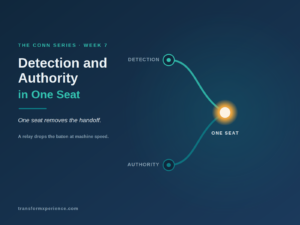
In naval command, the officer who holds the conn owns the vessel’s course. Detection and authority sit in one seat. A named human who reads the field, calls the correction, and answers for where the ship goes.
Organizations need the same seat. A named controller who answers for the elimination treatment. A named CFO who answers for the board pack. A named treasury manager who answers for the cash position the agent recommended. That seat is not the data scientist or the IT team. It is the executive who can say yes, no, or slow down when the system is pulling the business forward.
The conn is not blame assignment. It is drift control. It is the person accountable for noticing the ripples while they are still ripples, before they reach the hull.
These are not three topics. They are one continuum. Drift is the condition. The conn is the accountable seat. The operating model is what that seat runs.
Most organizations stop at the first two moves. They acknowledge drift, and they name someone accountable. Then they wonder why the pilots stall, why exceptions keep multiplying, and why trust never quite catches up to the technology. They are missing the third move. The conn needs an operating model.
A name is not enough
Here is where most accountability conversations stop, and where the real work begins. A name on the org chart is not detection authority. A named human with no operating model is a title, not a control. In practice, that gap shows up in three patterns.
The bolt-on pattern. Governance lives in a separate committee that meets quarterly, long after the automation has already made hundreds of decisions. By the time the risk appears, it is baked into the results, surfacing as a one-time adjustment that keeps coming back.
The hero pattern. One capable leader informally watches the use cases, the process changes, and the exceptions, because they know where the bodies are buried. When that person changes roles, governance resets to zero, and the organization learns how much was living in one person’s head.
The template pattern. Teams copy a policy from a larger enterprise or a regulator, then find that a sixty-page standard has no teeth in a four-hundred-person company with one stretched IT lead. Compliance exists on paper, and people work around it to get anything done.
In all three, the conn has no instrument panel. They are accountable in theory and blind in practice. The conn needs two capabilities to hold the course. A way to govern well. A way to govern fast. Those are not the same thing, and most organizations have neither paired with the other.
That pairing is the operating model. It has two halves, and we built both.
The AGE Framework™: how you govern well
The AGE Framework, our Adaptive Governance Engine, is how you govern well. It treats governance as a continuum, not an event. Most organizations govern in bursts, and between the bursts the system runs unwatched, and drift sets in. The AGE Framework replaces the burst with a continuous discipline, defined by five characteristics. It is continuous, so it never stops watching. Adaptive, so it changes as the business changes. Embedded, so it lives inside the work rather than beside it. Measurable, so health is a number, not an opinion. And transferable, so the capability stays when we leave.
At the operating level, the AGE Framework makes three changes a mid-market organization can implement without standing up a PMO. It links risk to enterprise risk, so model, data, and automation risk roll into the same register as credit, operational, and cyber. It defines decision authority tiers, making explicit where the system acts on its own, where it recommends and a human decides, and where humans decide with the system as input only. And it sets a review cadence that fits your size, adding governance to the leadership rhythms you already run instead of new standing meetings.
The AGE Framework answers the question every executive should ask first. Are we governing well enough to trust what we built?
The Velocity Governance Framework™: how you govern fast
The Velocity Governance Framework is how you govern fast. It resolves the tension every leader feels and few settle. Speed and control read as opposites. Move fast and things break. Add governance and everything slows. VGF rejects the trade, on four principles. Speed over perfection, because a decision made at the right time beats a perfect one made too late, which means deploying governed pilots in 90 days instead of an ideal state in 18 months. Action-embedded controls, because the control belongs inside the step, not in a downstream queue. Real-time risk assessment, because risk reviewed quarterly is risk discovered late. And outcome-based compliance, because the test is whether the result is sound, not whether the form was filed.
Paired with the AGE Framework, governance stops being the brake and becomes the way you safely go faster. Standards turn into speed multipliers instead of friction. VGF answers the question every executive asks under pressure. Can we move at market speed without losing the thread?
Paired by design
Here is the move. Neither half is the operating model. The pairing is.
VGF™ moves the work. The AGE Framework™ keeps the work trustworthy as it scales. One is the engine of velocity. The other is the engine of continuity. They are not redundant. They are paired by design.
Run alone, each one fails in a predictable direction. VGF without the AGE Framework is fast, and the gains decay, because nothing sustains the discipline once the speed is unlocked. Drift returns as unreconciled exceptions, unexplained variances, and leaders quietly switching automations off. The AGE Framework without VGF is sustained, and slow, because nothing unlocks the velocity in the first place. Teams produce strong design documents that never reach production, or they lock into one safe use case while competitors learn faster.
Run together, they are the complete operating model for AI implementation in a mid-market organization. Two frameworks, built separately, designed to operate as one engine. That is the asset. It is what no competitor has, and it is what the conn runs.
For an organization at $50M to $2B in revenue, with stretched leadership and no appetite for a heavyweight PMO, that is the point. You need a model that fits on one page for the CEO and CFO, maps to how your teams work in your ERP, low-code platforms, and line-of-business systems, and scales across functions without reinventing governance for each new use case. That is what the AGE Framework and VGF do together.
From a name to a seat
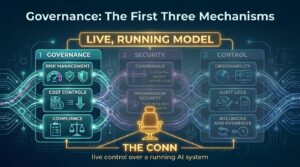
Return to the conn. The named human who answers for the course now has something to hold. Not a slogan. An operating model. The AGE Framework tells the conn whether the system is trustworthy. VGF lets the conn move without freezing. Together they turn a name on the org chart into a seat that carries both the name and the instrument. That is where drift turns from an invisible condition into a managed variable, and where AI stops being a collection of pilots and becomes part of how the organization runs on purpose.
In practice, that looks like a single, explicit owner for the decisions and automation that carry risk, a catalog of use cases each tagged with its decision authority and its key controls, and a governance rhythm that fits: weekly operational checks on the workflows that matter, monthly reviews by the owners, and a quarterly executive look at the portfolio, the risk posture, and what comes next.
That is operational fortitude. Drift is the failure. The conn is the answer. The paired operating model is what the answer runs on. You can build it, own it, and run it after we leave. That is the point of the pairing, and the point of the firm.
See where your organization stands. If you are staring at a wall of green dashboards and wondering what you are not seeing, this is the next conversation. The Transformation Pulse carries the playbook, new every week, on LinkedIn. For a working read on your own operating model, the Executive Readiness Session maps your current portfolio, scores drift risk, and designs the first version of your conn seat, AGE Framework, and VGF in your context, not in theory. You leave with a one-page operating model and a 90-day action plan.
Govern well. Govern fast. Paired by design.


One Response
Great content! Keep up the good work!