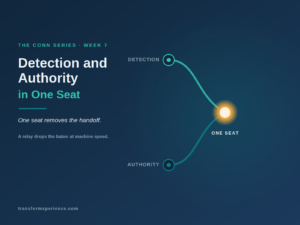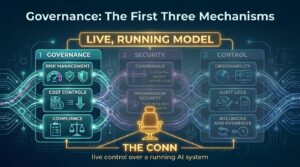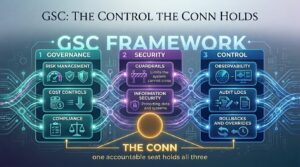
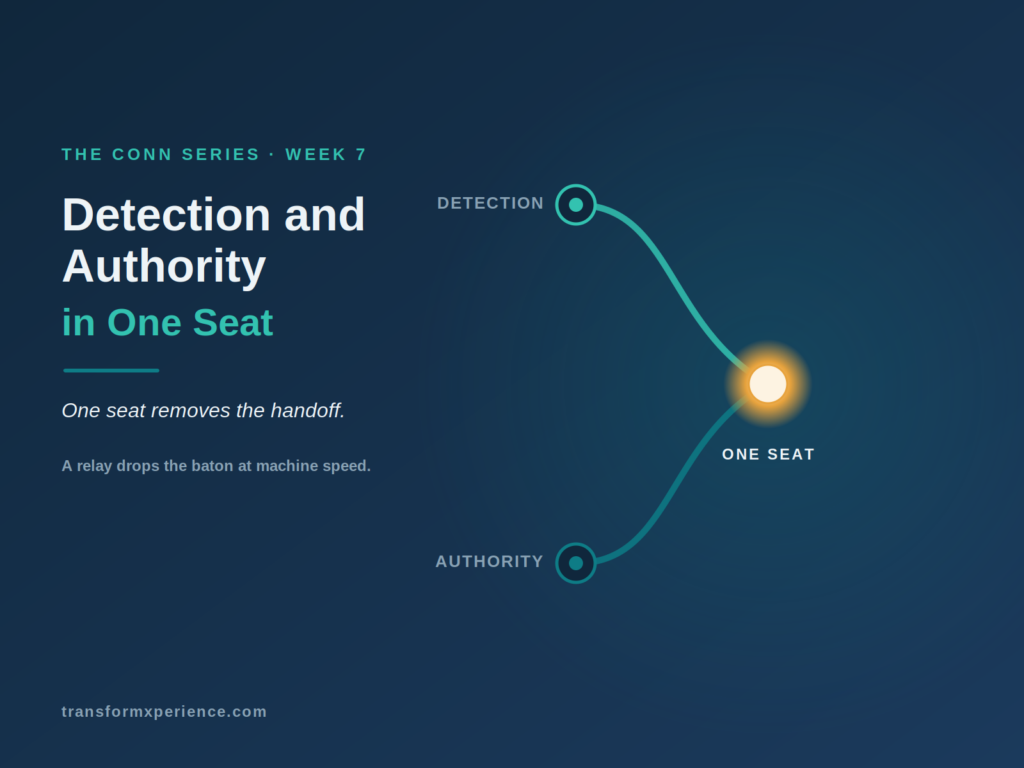
The conn is the named, accountable human who holds detection and authority in one seat, and who runs the operating model against drift. There is one phrase in that definition people skim past, and it carries the whole design: in one seat.
Read most versions of AI accountability and you will find detection and authority both present somewhere in the organization. What you will rarely find is those two held together in one accountable place. This post is about why that matters, and why splitting them is the most common way organizations think they have the conn when they do not.
The First Half: Detection
Start with detection, because it is the half most people misjudge. Detection is not a quarterly audit or an annual review. It is near real-time observability into whether what your operation runs still matches what you decided it would run. The conn can see the drift while it is still small, in the window where a correction is cheap and quiet, before it has executed across the whole book of business.
Most organizations have dashboards, monitoring, and reports, and those tools reveal real things: performance issues, output anomalies, control exceptions. What they do not settle on their own is whether the rule the system is running is still the right rule. That is the read the AGE Framework™, our Adaptive Governance Engine, is built to give. Not did it run, but is what it is running still true. And even that read is only half the seat, because a signal no one is accountable for acting on is not detection in the sense the conn needs. It is information.
The Second Half: Authority
Now authority, the half that gets diluted. Authority is the standing to act on what detection surfaces. To pause the automation, retune it, or stop it. The test is the same here: the conn can say yes, no, or slow down when the system is pulling the business forward. If a seat can see the drift but cannot halt it, it has detection without authority, and detection without authority is only a well-informed bystander.
Authority is not the power to make every business decision. It is narrower and sharper: the standing to stop the machine the moment it crosses the line, and to convene the people who own the fix. But that standing has to be real. A seat that has to file a request and wait for sign-off to pause a drifting system does not have authority. It has a suggestion box.
The Trap: Two Seats
Here is where organizations fool themselves. They have detection. They have authority. They have them in different seats. The people close to the data and the models can see the drift first. The executives who can halt a business process sit a few levels up. Between them is a handoff. An escalation. A meeting. A thread.
And a handoff has latency. At human speed, that latency was survivable, because the drift moved slowly enough that a few days of escalation did not matter. At machine speed, on the automations that can move real money or real risk, it is not. The agent does not pause while your escalation works its way up the chain. It keeps running the drifted rule, across the affected cases, for the whole length of the gap between someone noticing and someone with the power acting.
Picture the gap in calendar time. A monitoring analyst flags a drifted underwriting rule on Monday. The executive who can halt it reviews the escalation on Thursday. For those three days, the system keeps issuing decisions on the drifted rule, at machine speed, the whole way through.
You built a relay, and relays drop the baton at machine speed.
Why One Seat, Not Coordination
The instinct is to fix the relay with better coordination. A tighter escalation path. A responsibility matrix. A cross-functional review. Each one tries to make the handoff faster. But you cannot coordinate your way to the response time a high-speed, high-impact automation demands. Every handoff adds delay, and when the system can create material harm before the next decision point, that delay becomes exposure.
One seat is not a coordination improvement. It is a defined accountability design. The seat that owns detection also holds the pre-agreed authority to invoke the response when defined conditions indicate material drift: pause, contain, escalate, or stop. The correction may involve many people. The decision to stop further automated harm cannot wait in a queue. When the person who sees the drift is the same person who can halt it, there is no gap between detection and action, because there is nothing to hand off. That is why the conn is one seat and not two well-meaning roles that promise to talk to each other.
What One Seat Does Not Mean
Be clear about what this does not require. It does not mean one person watches every transaction, and it does not mean one executive personally holds every automation in the company. For each material automation, one named seat holds the authority to invoke the agreed response, pause, contain, escalate, or stop, when defined conditions are met. The conn holds the instruments and the operating model that surface the drift; they are not staring at a screen all day, and they do not fix everything alone. When drift appears, they halt it and pull in the people who own the correction. One seat is about where the accountability for seeing and stopping lands, so there is no gap for the drift to run through. The work spreads across your team. The accountability does not.
The Test for Your Operation
So here is the test, and it is simpler than any maturity model. Name the conn for each material automation. When defined conditions indicate drift, can that seat invoke the response the automation demands, pause, contain, escalate, or stop, inside the window it requires? If the answer is no, if detection and the authority to act sit in different seats with a process in between, you do not have the conn yet. You have a relay, and you are one machine-speed drift away from finding out where the baton drops.
The next posts in this series turn the question on your own organization and take on the part people resist most: why holding the conn is drift control, not blame, and why the conn can be wrong and still be doing the job.
| Map Your Detection-to-Authority Gap An Executive Readiness Session maps exactly that: who owns detection, who can invoke the response, and where the handoff between them is costing you response time you cannot afford. Book one at transformxperience.com. |