Ask a room of executives who governs the AI, and you get a committee. A steering group, a council, a monthly review with a slide deck and a quorum. That is what the word has come to mean. A place where people meet.
Hold that against how AI runs. The model applies what it inherited at machine speed, across every case, every period, without waiting. A committee meets on the third Tuesday. Drift does not wait for the third Tuesday. Governance as a room that convenes is governance that arrives after the damage. It is a postmortem with catering.
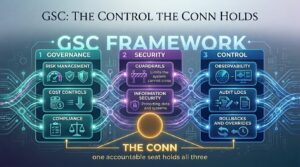
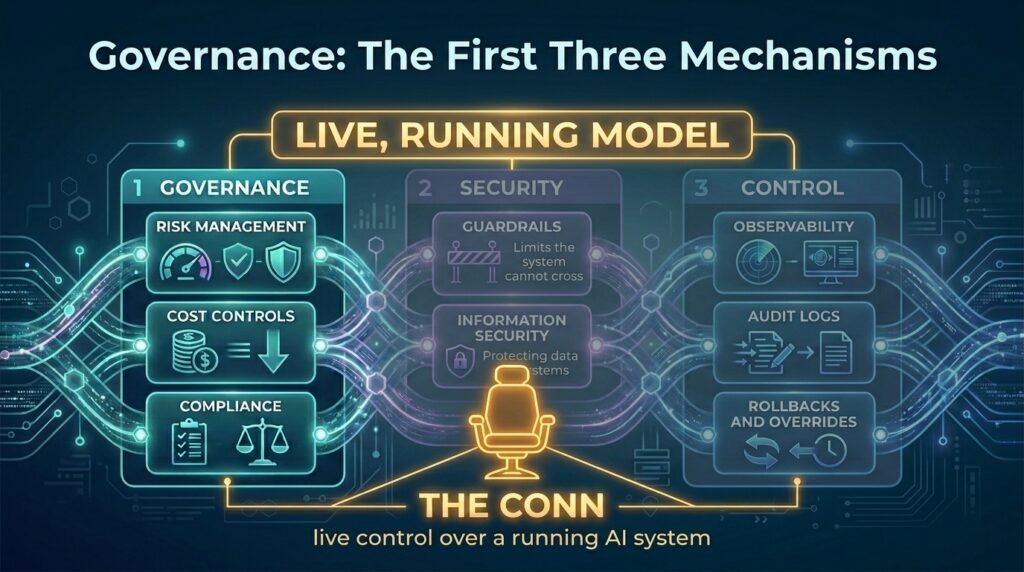
The first block of GSC takes the word back. Governance here is not a committee. It is three live mechanisms the conn operates continuously against a model that never stops running: risk management, cost controls, and compliance.
| Governance is three mechanisms, not a committee. |
One word on terms. When we say the running model, we mean the live AI system: its model, its data, its tools and workflow, the decisions it makes, and the human handoffs around it in production. Not only the underlying model. Each mechanism below reads that live system, not a document about it.
One. Risk management, read live
Risk management, as most organizations run it, is an event. Once a year someone builds a register, a list of things that could go wrong, rated high, medium, low. It gets reviewed and filed. By the time the model has run for a quarter, that register describes a system that no longer exists.
As a GSC mechanism, risk management is live. It is the conn’s continuous read on what could go wrong in the running model and what it would cost if it did. Not the risks you named in planning. The risks the system is carrying right now, at the speed it is running. A model that inherited an assumption and applies it at scale is not carrying the risk you registered in the spring. It is carrying a new one it manufactured in production. The register never saw it. The mechanism does.
Two. Cost controls, in the window
An AI model in production does not only decide. It consumes. Every call, every inference, every retry carries a cost, and when the model drifts, the spend drifts with it. A retry loop that should fire once fires forty times. A query that should touch one record scans the whole table. None of it turns a light red. It shows up as a number at the end of the month that no one can explain.
Cost controls, as a GSC mechanism, is the conn’s live read on whether the model is spending what it was authorized to spend. A finance report tells you what you spent, in the past tense. This mechanism tells the conn what the model is spending now, and gives the seat the standing to stop a runaway before it becomes a budget event. That is the difference between reconciling cost after the fact and controlling it in the window where it is still small.
Three. Compliance, read from behavior
Compliance is the mechanism with teeth, and the one most organizations are most confident about, which is what makes it dangerous. You passed the audit. You hold the certificate. The rule was met on the day someone checked. And then the model kept running. The rule did not change. The model did. Somewhere in the drift it stopped matching the rule it was certified against, while the certificate on the wall still says otherwise.
Compliance, as a GSC mechanism, is the conn’s live read on whether the running model still obeys the rules it is required to obey. It does not read the certificate. It reads the behavior. Not did we comply on the audit date, but is the model complying right now, in the decisions it is making this hour. This is the mechanism where being wrong ends up in front of a regulator, a court, or a board, and where someone has to have been watching and able to act.
Read together, in one seat
Named one at a time, these look like three separate dashboards. In the running system they are one. A single drift event usually trips all three at once. The old assumption raises the risk, inflates the cost, and breaks the rule in the same hour. In most organizations risk, finance, and compliance sit in three functions on three clocks, each seeing its own piece late. The drift lives in the seams between them.
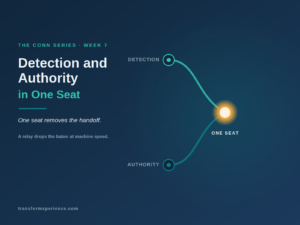
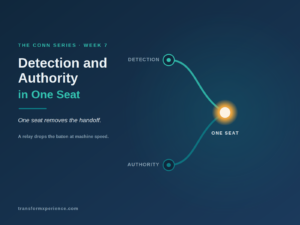
Governance in GSC closes those seams. It does not add a fourth function. It defines the three mechanisms as one block, read by one accountable seat, with the authority to act. That authority is defined, not unlimited, and not improvised in the moment. The conn does not wait for three functions to reconcile their versions. The conn reads the pattern across all three, because cost up, exposure up, and compliance slipping at the same time is not three problems. It is one drift event with three signatures. TXP builds that block so the seat that sees the pattern is the seat that can stop the model.
Governance is the first block the conn holds. Three live mechanisms, read together, in one seat. Not a committee, not a binder, not a platform. Security and Control complete the structure.
| Follow the full GSC build. The Transformation Pulse carries the weekly through-line as the season assembles the operating model, the conn, and the eight mechanisms the conn holds. Subscribe from the Insights hub. Resource: the Velocity Governance Framework White Paper is available from the Insights hub. |