By Michelle McKinney, CEO and Founder, TransformXperience LLC
Reading time: 9 minutes
Most program managers know when a project is in trouble. The status reports turn red. The steering committee asks hard questions. The budget burns faster than planned.
But misalignment is different. It does not announce itself with red flags. It whispers. It hides inside meetings that feel productive but produce nothing. It lives in teams that are working hard but pulling in different directions. By the time misalignment shows up on a status report, the damage is already done.
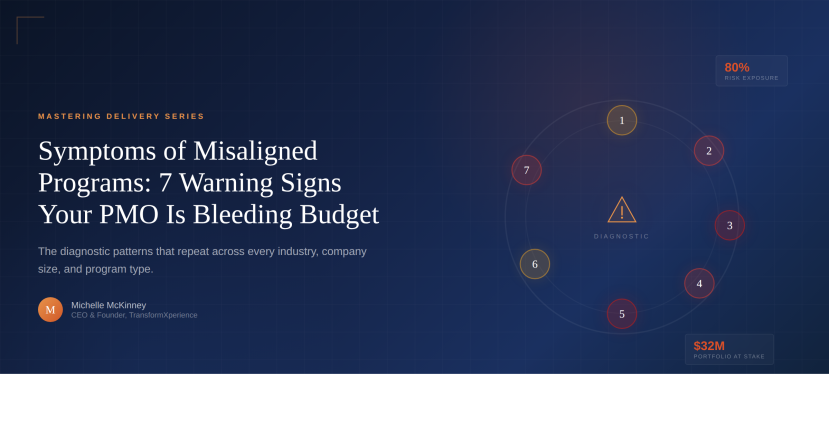
In our Mastering Delivery series companion post, The Hidden Costs of Program Misalignment, I shared how alignment failures at Delta Air Lines created an 80% risk exposure across a $32 million portfolio before intervention. At SunTrust Bank, a $15 million enterprise data program required full rescue because three divisions built separate master data solutions without coordinating.
This post goes deeper into the diagnostic side. These are the symptoms I have seen repeat across every industry, company size, and program type in 27 years of transformation work. From Fortune 500 companies like Coca-Cola and Norfolk Southern to Big 4 consulting at Accenture and Ernst & Young to mid-market PMO buildouts at Gwinnett County Government. Misalignment always leaves the same fingerprints.
If you have read our blog post Why IT Projects Fail: 7 Warning Signs Your PMO Is Missing, you already know the macro-level failure patterns. This post zooms into the program-level version of those failures. The dynamics that play out when multiple project teams are supposed to be working toward the same goal but are not.
If three or more of these symptoms describe your program, you are likely bleeding budget right now.
Symptom 1: Teams Are Busy but Progress Is Stalling
This is the most deceptive symptom. Every team reports 100% utilization. Sprint velocity looks healthy. Timesheets are full. But when you zoom out to the program level, the needle is barely moving.
Activity is not the same as progress. In misaligned programs, teams are doing real work. The problem is that their work does not connect to what other teams need.
What I saw at Delta: Before alignment intervention, the $32 million portfolio had resource over-allocation running at dangerous levels. People were committed to multiple workstreams with no prioritization framework. Everyone was busy. Delivery success was low. After establishing unified governance, delivery success increased 95% and resource over-allocation dropped 90%.
What to look for: Individual project dashboards show green while the program dashboard stays yellow or red. Resource utilization is high but milestone completion rates are low. Teams are producing deliverables that require rework at integration points.
Symptom 2: The Same Decisions Keep Getting Revisited
You had the meeting. You made the decision. Everyone nodded. Three weeks later, the same topic resurfaces in a different forum. Different stakeholders. Different conclusions. The team is back to square one.
Decision recycling is a classic alignment failure. It happens when governance structures are unclear. When decision rights are not defined. When there is no single source of truth for what was decided, by whom, and why.
What I saw at SunTrust Bank: The $15 million Enterprise Data Organization program was in distress specifically because governance was fragmented across divisions. Decisions made in one forum were revisited in another. We partnered with IBM DRM to establish a unified reference data platform and clear decision authority. The program recovered.
What to look for: Meeting minutes that contradict each other. Steering committee discussions that cover the same ground as last month. Team leads who say ‘I thought we already decided this.’ Scope changes that undo previous scope changes.
Symptom 3: Dependencies Are Discovered, Not Planned
In aligned programs, dependencies are mapped at initiation and tracked throughout execution. In misaligned programs, dependencies are surprises. ‘We did not know Team B needed our data model finalized before they could start UAT.’ ‘Nobody told us the vendor contract required our sign-off first.’
This is not a planning failure. It is an alignment failure. When teams are not sharing a unified program view, they cannot see how their work connects to everything else.
What I saw at Travelport: Managing a $50 million+ application portfolio, we found that mission-critical systems had interdependencies that were invisible to individual teams. SAFe methodology alignment was the solution. It connected teams that had been operating in parallel without shared objectives, making dependencies visible before they became blockers.
What to look for: Last-minute escalations about blocking issues. Integration testing that reveals incompatible data formats. Teams idle waiting for deliverables from other teams without a planned handoff date.
Symptom 4: Stakeholders Are Getting Different Stories
The CIO hears the program is on track. The VP of Operations hears it is at risk. The project sponsor thinks the scope was reduced last quarter. The program manager thinks it was expanded.
When communication channels are fragmented, every stakeholder builds their own version of reality. None of them are wrong. None of them are complete. And when these versions collide in a steering committee meeting, trust erodes fast.
What construction taught me: In my 20 years running a general contracting business, I learned that miscommunication between the architect, the subcontractor, and the inspector does not just cause confusion. It causes walls to get opened twice. It causes inspections to fail. It causes investors to pull funding. I brought that same zero-tolerance approach to stakeholder communication in IT programs. One version of the truth. Updated in real time. No exceptions.
What to look for: Stakeholders quoting different completion percentages. Reports that contradict each other depending on which team produced them. Executive sponsors surprised by information that was available at the project level for weeks.
Symptom 5: Blame Replaces Problem-Solving
When misalignment festers long enough, the culture shifts. Instead of ‘how do we fix this,’ the conversation becomes ‘who caused this.’ Retrospectives turn into finger-pointing sessions. Teams start protecting themselves instead of collaborating.
This is not a people problem. It is a structural problem. When accountability is ambiguous and governance is unclear, teams naturally default to self-preservation.
What I saw at Gwinnett County: When I was brought in to build the IT PMO from scratch, there was no governance framework at all. A $10 million portfolio with zero program-level structure. Teams were siloed and defensive because there was no shared accountability model. Building clear governance and communication protocols transformed the culture. Project failure rates dropped 75%.
What to look for: Retrospectives focused on who failed rather than what failed. Email chains where people CC executives to create paper trails. Teams that stop volunteering for cross-functional work. Rising contractor usage because internal teams do not want the risk.
Symptom 6: Scope Changes Happen Without Program-Level Impact Analysis
A project manager approves a scope change for their project. It makes sense at the project level. But nobody assessed how that change affects the three other projects that depend on the original scope. The data model changes. The integration points shift. A single change request cascades into weeks of unplanned rework across the program.
This happens when change control exists at the project level but not at the program level.
What I saw at IHG: The $19 million+ global reservations re-platform spanned both digital and voice channels. Changes in one channel directly impacted the other. Agile SCRUM adoption helped, but the real breakthrough was establishing program-level change governance that assessed cross-channel impact before any scope modification was approved. The program achieved zero security incidents and stayed aligned across both delivery tracks.
What to look for: Change requests approved by individual project leads without program-level review. Scope changes in one project that trigger surprise work in another. Integration defects traced back to a change made months earlier in a different workstream.
Symptom 7: Success Metrics Vary by Team
Ask the IT team what success looks like. They say system uptime and integration completion. Ask Operations. They say process efficiency. Ask Customer Experience. They say NPS scores.
None of these are wrong. But when each team is optimizing for different outcomes, the program as a whole suffers. Trade-offs are made without understanding the full program impact. And when it comes time to report program-level results, nobody can agree on whether the program succeeded or failed.
What I saw at Kaiser Permanente: The $20 million+ digital transformation programs required alignment across clinical, IT, and administrative stakeholders. Board of Directors technology modernization demands met Azure Cloud migration requirements met AI/ML implementation timelines. Without unified success criteria that bridged all three perspectives, each group would have optimized for their own metrics at the expense of the program.
What to look for: Teams that cannot articulate how their project contributes to the overall program objective. KPI dashboards that measure different things across projects within the same program. Steering committee debates about what ‘done’ means.
The Diagnostic: How Many Symptoms Apply to You?
Here is the honest math. Every program has friction. One or two of these symptoms in mild form is normal. Three or more signals a structural alignment problem that is actively costing you money.
| Symptom Count | Risk Level | Recommended Action |
| 1-2 Symptoms | Monitor | Track these indicators monthly. Build awareness across project leads. |
| 3-4 Symptoms | Elevated | Conduct a formal alignment assessment. Establish program-level governance if it does not exist. |
| 5-6 Symptoms | Critical | Initiate a program alignment review immediately. Hidden costs are likely accumulating at 40-60% of overruns. |
| 7 Symptoms | Program at Risk | Engage external support. Internal teams are likely too embedded in the current structure to diagnose objectively. |
Continue the Mastering Delivery Series
This post is part of the Mastering Delivery series on program alignment. Here is where to go next based on what you need:
Understand the financial impact: The Hidden Costs of Program Misalignment: What Your Budget Reports Won’t Tell You breaks down where misalignment costs actually hide and how to quantify them. Includes the Delta $32M case study in full financial detail. (/the-hidden-costs-of-program-misalignment-why-your-budget-is-bleeding/)
Get the fix: The Alignment Framework: A Practical Model for Getting Programs Back on Track walks you through the five-pillar Velocity-Governance Framework developed across 14 enterprise engagements. (/the-alignment-framework/)
Build executive support: Building PMO Credibility with the C-Suite: How to Earn Executive Trust Before You Need It covers the leadership dimension of making alignment stick. (/building-pmo-credibility-c-suite/)
Related Reading from Our Blog
These published articles on transformxperience.com go deeper on topics referenced in this post:
On PMO failure patterns: Why IT Projects Fail: 7 Warning Signs Your PMO Is Missing covers the macro-level failure patterns that this post zooms into at the program level. If you have not read it yet, start there. (/why-it-projects-fail-warning-signs/)
On program rescue: From Red to Green: Why 84% of Rescues Fail explains what distinguishes a successful program rescue from one that just delays the inevitable. Relevant if your diagnostic score is 5+ symptoms. (/from-red-to-green-why-84-of-program-rescues-fail/)
On schedule and budget recovery: Overcoming Program Delays and Budget Overruns provides the tactical playbook for programs already showing slippage. (/overcoming-program-delays-and-budget-overruns-a-strategic-playbook-for-pmo-leaders/)
On governance frameworks: Data Governance Done Right covers the data governance foundation that every aligned program requires. (/data-governance-done-right-building-trust-compliance-in-your-data/)
About the Author
Michelle McKinney is the CEO and Founder of TransformXperience LLC. Over 27 years, she has diagnosed and resolved alignment failures across 14 major client engagements spanning healthcare (Kaiser Permanente), aviation (Delta Air Lines, $32M portfolio), travel technology (Travelport, $50M+ portfolio), financial services (SunTrust Bank, $15M program rescue), hospitality (IHG, $19M+ re-platform), and government (Gwinnett County, PMO built from scratch). Her early career at Fortune 500 companies including Coca-Cola, Norfolk Southern ($42M data center migration), and BellSouth built the diagnostic instincts she applies today. She also spent 20 years running a general contracting business, which taught her that misalignment has real, immediate financial consequences.