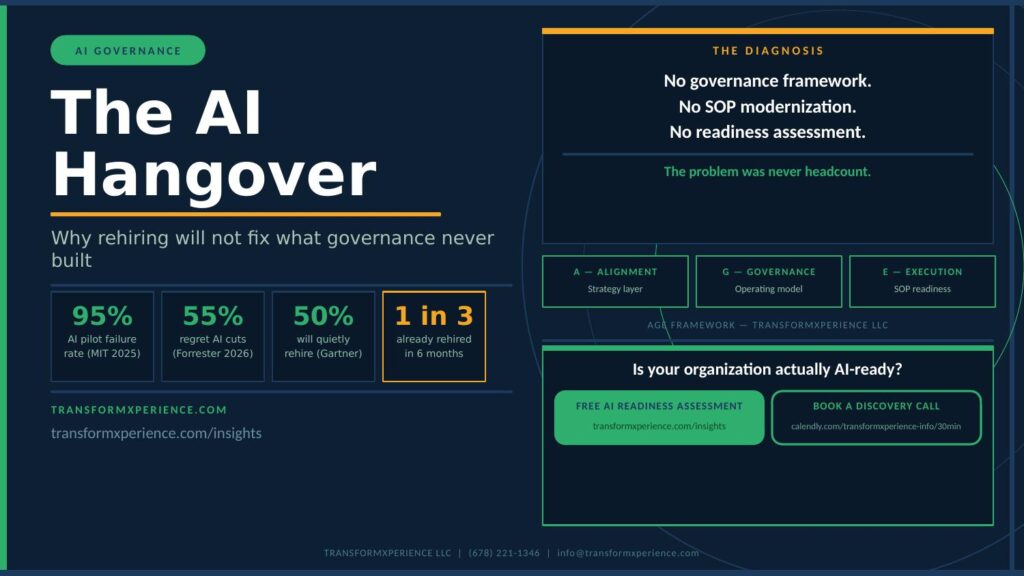
95% failure rate. 55% regret. 50% rehiring. And the real problem is still sitting untouched in every boardroom that made the call.
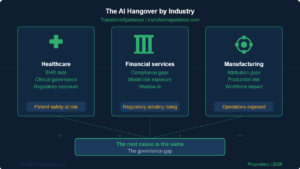
There is a pattern playing out right now in boardrooms across healthcare, financial services, manufacturing, and technology. It does not have a press release. It does not show up in earnings calls. But if you know what to look for, you can see it in the quiet job postings, the rehire conversations happening behind closed doors, and the performance reviews where AI productivity targets are not being met.
It is called the AI Hangover.
You know the story. Company announces AI-driven workforce reduction. Stock ticks up. Board applauds. Six months later, the numbers are not there. The AI is running. The headcount is gone. The operating model is still broken. And now the organization is trying to figure out how to quietly fill the gaps without admitting that the original decision was based on a promise the technology was never positioned to keep.
| The cut was the headline. The governance gap was always the crisis. And most organizations still have not diagnosed it. |
This blog is for the leaders sitting in that gap right now. And for the ones who have not made the cuts yet and are wondering if they should.
The Data Is In. And It Is Not Comfortable.
While companies have been busy announcing AI efficiency gains, researchers have been tracking what actually happens next. The numbers tell a story that nobody in the C-suite is sharing publicly.
| 95% of enterprise AI pilots fail to deliver measurable financial returns (MIT, 2025) | 55% of companies that made AI cuts in 2025 already regret the decision (Forrester) | 50% of AI-attributed layoffs will result in rehiring for similar roles by 2027 (Gartner) |
| 1 in 3 companies that made AI cuts already rehired more than half the roles they eliminated within 6 months (Careerminds, 2026) | 6 in 10 companies admit they frame layoffs around AI to make the decisions more acceptable, often hiding financial struggles (Resume.org) |
Let the 95% number sit for a moment. Nearly every enterprise AI initiative is failing to produce the returns that justified the investment. And yet companies are cutting thousands of roles based on the promise of those returns. The math does not work. And the reason it does not work has nothing to do with the technology.
The Real Problem Was Never Headcount.
Here is the diagnosis that nobody is making out loud in the organizations living through this right now.
AI did not fail because the tools were inadequate. AI failed because the organizational infrastructure required to make those tools perform was never built. The governance model that defines who owns AI decisions, how outputs are validated, what happens when the system is wrong, and how the organization course-corrects was never put in place. The standard operating procedures that translate AI capability into operational reality were never modernized. The readiness assessment that would have revealed whether the data environment, the leadership infrastructure, and the process foundation were ready to support production AI was never conducted.
Instead, organizations moved in this sequence: adopt the tool, announce the efficiency, cut the people, wait for the results.
| The correct sequence is: assess readiness, build governance, modernize processes, then deploy at scale. Most organizations skipped steps one through three. |
Rehiring does not fix this. The people walking back in the door will face the same broken operating model that existed before the cuts. The AI will still have no governance framework to run inside. The decision rights will still be unclear. The SOPs will still be built for human-executed workflows. The board will still be asking questions nobody can answer.
You cannot rehire your way out of a governance problem.
The Three Gaps That Created the Hangover
When TransformXperience works with organizations navigating AI disappointment, three gaps surface consistently. Not one. Not two. All three. And all three were present before the first cut was ever announced.
| 01 | No AI Governance Framework AI governance is not a compliance checkbox. It is the operating structure that determines who owns AI decisions, how outputs are validated, what happens when the system produces a wrong answer, and how the organization course-corrects when it does. Without it, every AI deployment is operating without a safety net. Organizations that cut aggressively and then discovered their AI was producing unreliable outputs had no governance mechanism to catch the failure before it became a business problem. |
| 02 | SOPs Never Modernized for AI-Ready Operations Standard operating procedures built for human-executed workflows do not transfer to AI-executed workflows. The handoffs are different. The exception handling is different. The accountability chain is different. Organizations that deployed AI on top of unchanged SOPs discovered this the hard way, when processes broke in ways that took longer to diagnose than the original manual process ever would have. SOP modernization is not glamorous work. It is the foundation that makes AI deployment stable. |
| 03 | No Readiness Assessment Before the Decision The AI tools were evaluated. The vendor demos were impressive. But nobody asked whether the organization’s data infrastructure, leadership decision rights, and process foundation were ready to support what AI would require from them. The tool was sound. The foundation was not. Organizations that assess before they invest consistently achieve faster time-to-value, higher adoption rates, and better ROI on AI initiatives than those that deploy without a readiness foundation. |
The Framework Behind the Fix: The AGE Model
At TransformXperience, we built the AGE Framework specifically because the standard consulting approach to AI readiness was not closing the right gaps. Most assessments measure technology maturity. AGE measures organizational readiness at the system level, which is where AI actually succeeds or fails.
AGE stands for three integrated dimensions of organizational AI readiness:
| A Alignment Is your AI strategy aligned to defined business objectives? Do leadership, operations, and technology share a unified definition of what AI success looks like? | G Governance Do you have the operating structure to own AI decisions, validate outputs, manage risk, and course-correct when the system fails? | E Execution Are your SOPs, data infrastructure, and change management processes modernized to support AI-driven workflows at production scale? |
The AGE Framework is a proprietary TransformXperience methodology protected under copyright registration Case 1-15111873701. It is the diagnostic engine behind every AI readiness engagement we conduct and the reason our clients close the governance gap instead of continuing to paper over it.
| Most organizations score strong on Execution (they have tools and people) and weak on Alignment and Governance (they do not have the strategy or the operating structure to make those tools deliver). That imbalance is the AI Hangover. And the AGE Framework is how you diagnose it before it costs you another round of cuts. |
What Organizations That Get This Right Do Differently
The companies coming out of this moment stronger are not the ones that moved fastest on AI. They are the ones that stopped before the announcement and asked the governance question first. Here is what that looks like in practice.
- They conducted an AI readiness assessment across all four dimensions: data environment, technology infrastructure, workforce capability, and strategic alignment. Before a single role was eliminated.
- They mapped decision rights explicitly. Who owns AI outputs? Who escalates when the system is wrong? Who has authority to pause a deployment?
- They modernized SOPs for AI-ready workflows before deploying automation. Not after the process broke.
- They built change management into every AI initiative from day one, not as an afterthought when adoption stalled.
- They brought the governance conversation to the board before the investment decision, not after the returns failed to materialize.
None of this is about slowing down AI adoption. It is about making AI adoption actually work. Organizations that assess before they invest consistently achieve faster time-to-value, higher adoption rates, and better ROI than those that deploy without a readiness foundation.
What Leaders Should Do Right Now
If your organization is in the middle of an AI initiative, planning workforce decisions around AI efficiency, or already navigating the quiet crisis of returns that have not materialized, here is where to start.
- Stop asking what AI can replace. Start asking where you are unclear on governance, decision rights, and process ownership. That clarity gap is what AI will expose. Fix it first.
- Conduct a readiness assessment before the next investment decision. Not after. The AGE Framework gives you a structured view of where your organization actually stands across Alignment, Governance, and Execution.
- Modernize your SOPs for AI-ready operations. If your standard operating procedures were written before AI entered your workflows, they are not ready to govern what AI is doing inside your organization right now.
- Bring the governance conversation to your board now. Regulators are moving. Colorado SB 24-205 takes effect June 2026. The EU AI Act is in enforcement mode. Your board needs answers you may not yet have.
- If you are already rehiring, do not just refill seats. Rebuild with governance underneath. The roles coming back need a different operating model to walk into, not the same one that produced the disappointment.
| The organizations getting the most from AI are not the ones who moved fastest. They are the ones who moved right. Assess first. Govern always. Then scale. |
| Is Your Organization Actually AI-Ready? STEP 1: Take the Free AI Readiness Self-Assessment Your team can earn every AI certification on the market and still fail at implementation. The gap is not skills. It is organizational readiness across Alignment, Governance, and Execution. The AI Readiness Self-Assessment gives you a structured view of where your organization stands before the next decision gets made. Download free at transformxperience.com/insights STEP 2: Book a 30-Minute Discovery Call Whether you need a rapid AI Readiness Assessment, a full PMO Modernization engagement, or a governance sprint to close the gaps the assessment reveals, we meet you where you are. No pitch. No slides. Just a direct conversation about what your organization is navigating and what it would take to fix the foundation. Book at calendly.com/transformxperience-info/30min |
About the Author
Michelle McKinney is the CEO and Founder of TransformXperience, an AI-powered IT consulting firm specializing in PMO modernization, AI readiness assessments, and SOP Modernization for AI-Ready PMOs. With 44 years in technology, she has managed programs exceeding $200 million in value across Fortune 500 companies and healthcare organizations. She is the creator of the AGE Framework, a proprietary methodology for diagnosing and closing organizational AI readiness gaps. She hosts The Daily Byte, a live leadership intelligence series airing Monday through Friday at 8:30 AM.