
AI certifications are multiplying. But your organization is not ready because your employees passed an exam.
Something significant is happening in the AI space right now. Certification programs are multiplying. Vendors are launching credentialing tracks. Employees are rushing to add AI credentials to their LinkedIn profiles. There is a real market signal in all of that activity, and leaders are right to take note.
But there is a serious risk hidden inside the momentum.
Organizations are beginning to equate individual AI skills with organizational AI readiness. They are watching their teams earn certifications and concluding that the hard work is done. That the organization is now prepared.
It is not. And the leaders who understand that distinction early will be the ones who actually capture AI value. The ones who miss it will spend years wondering why their AI investments keep stalling.
| An individual can be certified and brilliant. The organization can still fail. The certification measures the person. Readiness describes the system. |
What the Certification Wave Is Actually Telling You
The surge in AI certifications is a leading indicator of market pressure, not organizational transformation. When employees start chasing credentials, it signals that leaders are communicating urgency about AI adoption. Teams are responding to that signal the way professionals have always responded: by getting trained.
That is not a bad thing. Competent people with AI fluency are a genuine asset. The problem is what happens next.
Most organizations stop there. They count certifications. They build dashboards showing how many employees completed AI training. They report progress to the board. And underneath all of that activity, nothing in the operating model has changed.
The data pipeline still cannot support production AI. The PMO still does not know how to govern an AI portfolio. The governance framework was written before large language models existed. The change management process assumes a traditional project lifecycle.
The certification answered a skills question. Nobody asked the readiness question.
The Difference Between a Skilled Team and a Ready Organization
Organizational AI readiness is not the sum of individual AI skills. It is a distinct capability that lives at the system level, not the person level.
Think about it this way. You can hire the best engineers in the world, but if your data infrastructure does not meet production requirements, your AI models will fail. You can train your entire project management office on AI tools, but if your governance processes are not redesigned for AI portfolios, your AI initiatives will stall. You can build a team fluent in prompt engineering, but if your leadership does not understand how to set AI strategy, your investments will scatter across disconnected pilots that never reach scale.
Organizations scoring high on readiness assessments share a specific set of characteristics. They have a defined AI strategy aligned to business objectives, not just a technology roadmap. They have addressed the four pillars of data readiness that AI models actually require. They have restructured their PMO governance to manage AI-specific risks, cycles, and outcomes. They have built change management into every AI initiative from the beginning, not as an afterthought. They have leadership that can make confident decisions about AI investments, not just approve budget line items.
None of those capabilities come from a certification exam.
| Readiness is what allows a certified team to actually deliver. Without it, certification is preparation without infrastructure. |
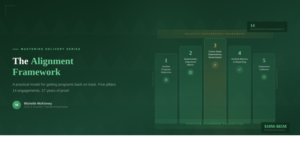
The Five Organizational Gaps That No Certification Closes
1. Strategic Use Case Alignment
Most organizations have AI activity without AI strategy. Individual teams are experimenting. Vendors are pitching solutions. Pilots are launching. But there is no shared framework for deciding which use cases align to business objectives, which investments to prioritize, or how AI fits the overall technology roadmap. Certifications teach people to build AI applications. They do not build the strategic decision-making infrastructure that determines which applications are worth building.
2. Data Foundation Readiness
AI models are only as reliable as the data they run on. Production-grade AI requires data that is complete, consistent, accessible, and governed. Most organizations discover during their first serious AI deployment that their data environment was never built for this. Data quality gaps that were manageable in traditional reporting become critical failures in AI models. This is a structural problem that no amount of training resolves.
3. PMO Governance for AI Portfolios
Traditional project management frameworks were designed for predictable, sequential work. AI initiatives do not follow that pattern. They require iterative development cycles, ongoing model monitoring, governance over training data, and outcomes measurement that looks nothing like a standard project closeout. Organizations that try to run AI portfolios through unchanged PMO processes consistently discover that their governance creates more risk than it manages.
4. Change Management Integration
AI deployment is organizational change, not technology deployment. When AI systems change how people work, what decisions they make, and which skills they need, the adoption challenge is human, not technical. Organizations with high AI readiness build change management into the project from day one. They define adoption metrics alongside technical milestones. They engage stakeholders before deployment, not after. Certified employees can build the AI. Without change management readiness, the organization will not use it.
5. Leadership Decision-Making Infrastructure
Executives are being asked to make high-stakes decisions about AI investments, governance, and risk without a reliable information framework. Which AI initiatives deserve continued investment? How do you evaluate AI vendor claims? What are your actual organizational risks? Leadership AI readiness is not about whether executives can use AI tools. It is about whether the organization has built the governance and visibility infrastructure that allows leaders to make confident, informed decisions at speed.
What Readiness Assessment Actually Reveals
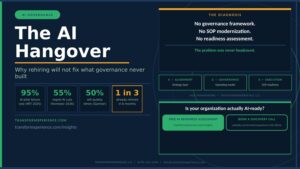
When TransformXperience conducts an AI readiness assessment with a leadership team, the results consistently surface the same pattern. Individual capability scores are higher than organizational readiness scores. The people are further ahead than the systems.
That is not a workforce problem. It is a governance and infrastructure problem. And it is exactly the kind of gap that stays invisible until an AI initiative fails.
The readiness assessment looks at four dimensions: data environment, technology infrastructure, workforce capability, and strategic alignment. Most organizations find that one or two dimensions are significantly underdeveloped relative to the others. That underdeveloped dimension is the one that will bottleneck every AI initiative, regardless of how many certifications the team has earned.
The goal of the assessment is not to slow down AI adoption. It is to make AI adoption actually work. Organizations that assess before they invest consistently achieve faster time-to-value, higher adoption rates, and better ROI on AI initiatives than those that deploy without a readiness foundation.
| The organizations getting the most from AI are not the ones who moved fastest. They are the ones who moved right. |
What Leaders Should Do Right Now
If your organization is in the middle of an AI certification wave, do not slow it down. Capable, AI-fluent employees are a genuine competitive advantage. But layer a readiness conversation on top of it.
Start by asking the right questions at the leadership level. Does your organization have a defined AI strategy aligned to business objectives? Has your data environment been assessed against production AI requirements? Has your PMO governance been redesigned for AI portfolio management? Are your change management processes built for AI-driven transformation? Does your leadership team have the visibility and governance infrastructure to make confident AI investment decisions?
If the honest answer to most of those questions is no, your certified employees are preparing to run a race on a track that has not been built yet.
The investment in readiness is not a delay. It is the difference between AI that delivers and AI that disappoints. TransformXperience has done this work with organizations across healthcare, financial services, and technology. We know what the gaps look like, and we know how to close them in a way that builds organizational capability, not consultant dependency.
Your team is getting certified. Make sure your organization is getting ready.
| IS YOUR ORGANIZATION ACTUALLY AI-READY? Your team can earn every AI certification on the market and still fail at implementation. The gap is not skills. It is organizational readiness. In 30 minutes, we will show you exactly where your gaps are and what to close first. Download the free AI Readiness Self-Assessment at transformxperience.com/insights, then book a discovery call at calendly.com/transformxperience-info/30min. The organizations that move forward are the ones that assess before they invest. Start here. |
About the Author
Michelle McKinney is the CEO and Founder of TransformXperience, an AI-powered IT consulting firm specializing in PMO modernization, AI readiness assessments, and SOP Modernization for AI-Ready PMOs. With 44 years in technology, she has managed programs exceeding $200 million in value across Fortune 500 companies and healthcare organizations. She hosts The Daily Byte, a live leadership intelligence series airing Monday through Friday at 8:30 AM.