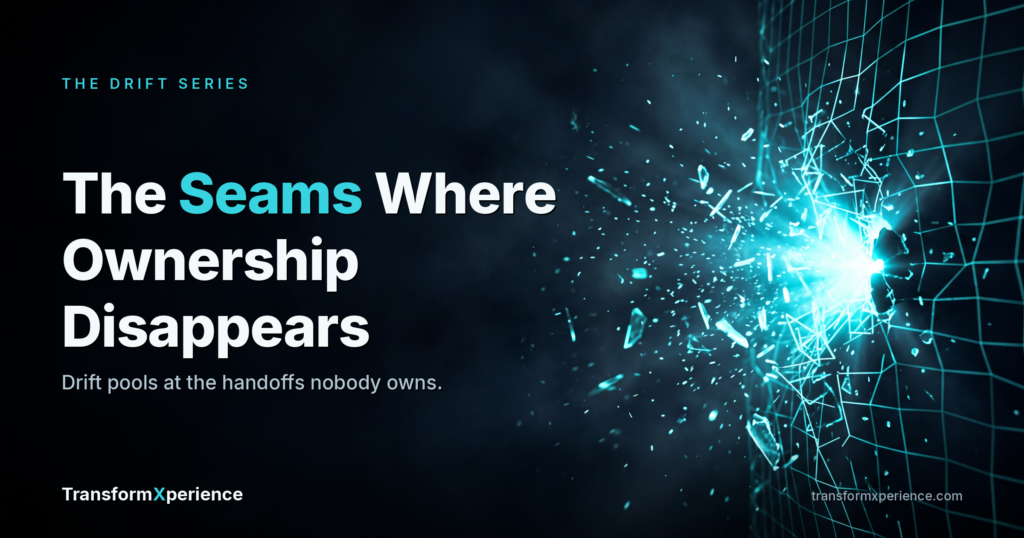
Drift does not spread evenly. It pools at the seams, the handoffs between functions, teams, and vendors, where each side is certain the other one owns it.
If drift has no owner by default, the next question is where the missing ownership hurts most. The answer is consistent across every organization I have worked in. It hurts at the seams. In a mid-market organization, where a handful of people and a few key vendors carry the whole operation, those seams are fewer and far more load-bearing.
A seam is any place where responsibility passes from one party to another. Business to technology. Your team to your vendor. The project that builds something to the operation that runs it. The leader who designed a system to the successor who inherits it. Inside a single team, someone at least feels responsible for the whole. At a seam, responsibility is meant to be shared, and shared responsibility has a way of becoming no one’s responsibility at all.
What a Seam Is
Picture two teams that each run a clean process. Team A hands off to Team B. Draw the two processes and they look complete. Now look at the space between them, the moment of the handoff itself. Who owns that moment? Team A believes their job ended when they passed it along. Team B believes their job started when the work arrived in a usable state. The handoff belongs to the gap between those two beliefs, and that gap has no name and no owner. Drift pools there because each side optimizes its own work, coordinated inside each team and uncoordinated across the seam.
Why the Usual Tools Do Not Help
The standard instruments of governance are built for boxes, not seams. A RACI chart assigns every box an owner and leaves the space between boxes to something it calls collaboration. An operating model from a large firm draws cleaner boxes and cleaner lines and still names no one for the handoff itself. A steering committee adds a meeting about the boxes. A vendor contract governs the boundary as it existed on signing day, while both sides drift away from it in opposite directions. None of these own a seam, because a seam is not a box, and nearly every tool the market sells is designed to manage boxes.
The Business and Technology Seam
The oldest seam in the enterprise. The business defines what it needs. Technology delivers against that definition. Over time the business changes what it needs and adapts locally, while the delivered system stays as specified. Each side is doing its job. The seam between intent and implementation widens, and you get the familiar complaint from both directions. Technology built the wrong thing. The business never told us it changed. Both are right. No one owned the seam.
The Team and Vendor Seam
When part of your running system lives inside a vendor, the seam runs straight through your contract. You own your side. They own theirs. The interface is governed by a document written at a moment in time, and both operations drift from that document in opposite directions. Your needs evolve. Their service evolves. The contract describes a relationship neither party runs anymore, and the first time something breaks at the boundary, the opening conversation is about whose responsibility it was, which is the conversation you have precisely because no one owned the seam while it drifted.
The Project and Run Seam
This seam quietly costs more than any other. A project builds a system, hits its milestones, and hands the result to the operation that will run it. The project team disbands. The operations team receives a documented system and begins running it, and from day one they adapt it, because running is nothing but continuous adaptation. The people who understood the original design are gone. The people living with the running system never saw the reasoning behind it. The distance between designed and run opens fastest right here, at the handoff from building to running, and there is rarely a seat that owns both sides of it.
The Leader and Successor Seam
The last seam is the one that moves the others. When a leader who built and understood a system is promoted or moves on, their successor inherits the documentation and the org chart, not the accumulated judgment. Every assumption the original leader carried in their head, every reason a control exists, every history behind a decision right, walks out the door with them. The successor governs what they can see, which is the documented system, while the running system keeps drifting on the strength of context that left the building. This is where the empty ownership seat becomes visible, because the knowledge needed to hold the standard is the thing that did not transfer.
Why Seams Are Where Drift Lives
Put the four together and a pattern emerges. Drift is worst wherever ownership is shared, because shared ownership without a named holder degrades into no ownership. Inside a function, someone feels the whole. At a seam, both sides feel their half, and the half that matters most, the boundary itself, is felt by neither. That is why inspecting your seams returns more than inspecting your teams. The teams are usually fine. The spaces between them are where the distance opens. When part of the running system is automated, the seam is also where human oversight was assumed but never assigned, a failure mode this series returns to shortly.
This is where budgets quietly bleed. The overruns that surprise leaders rarely come from inside a well-run team. They surface at integration, when two sides that each did their job discover the handoff no longer fits, and the rework lands on a schedule nobody planned. The cost was created at the seam long before it appeared on any report.
The Point
Drift concentrates at the seams, and the seams are exactly the places your org chart does not assign. Every function has an owner. The boundaries between functions have none. If you want to find the drift that is costing you most, do not audit the departments. Walk the handoffs, and at each one ask the question that keeps returning through this series. Who holds this?
We have named the threat. We have found where it hides and why it has no owner. The season now turns to the answer every one of these seams has been pointing at. Someone has to hold the line across the boundaries, on purpose, by name. Who that is, and how they run it, is where we go next.
Map the seams in your own programs
The Program Alignment Assessment Checklist helps you locate the handoffs where accountability disappears and quantify what the gaps are costing you, starting with the number that tends to surprise leaders most: how many critical handoffs in your programs have no named owner at all. Download it from the TransformXperience Insights hub, and subscribe to The Transformation Pulse to follow the case on who has to hold the line.