Ask who owns the gap between the system you documented and the system you run. In most organizations the honest answer is no one, and no hire, tool, or program the market sells you changes that.
Let me tell you about an owner who was promoted eight months ago.
She built a program well. Clear design, sound governance, the right controls in the right places. Then she earned a bigger role, as strong operators do, and moved up. Her old seat was backfilled. The new person inherited the responsibilities that were written down. Everyone did their job. And eight months later the running system had drifted from the documented design and no one had noticed, because the one thing never handed to anyone was ownership of the distance between the two.
This is not a story about a person who dropped the ball. Every person in it performed. It is a story about a seat that was never created. In most organizations the gap between the documented system and the running system has no owner by default, and understanding why is the difference between treating drift as a discipline problem and treating it as the structural problem it is.
This Is Not a Discipline Problem
When executives first see drift, the instinct is to reach for accountability language. People got sloppy. Standards slipped. We need to hold the line. I understand the instinct, and it aims at the wrong target. Drift is produced by competent people making sound decisions. Adding pressure to be more disciplined does not close the gap, because no individual is failing at their assigned job. The workaround was reasonable. The exception was justified. The optimization was an improvement. You cannot discipline your way out of a problem created by good judgment operating without a place to be reconciled.
How the Seat Goes Empty
Ownership in most organizations is assigned once, at design time, and then treated as permanent. We name an owner for the project. We name an owner for the system at launch. What we almost never name is an owner for the ongoing distance between what we designed and what we run, because at launch that distance is zero and an owner for zero feels unnecessary.
Then the organization does what living organizations do. It moves. People get promoted. Roles get renamed. Teams reorganize. The person who understood the original design leaves, and their replacement inherits the documentation, not the memory of why each choice was made. Every transition is handled correctly on its own terms. What no transition transfers is responsibility for the widening gap, because that responsibility was never a defined seat to begin with. It falls between the roles, and things that fall between roles do not get done. In a mid-market organization this happens quickly, because the person who designed a system and the person who runs it are often one promotion apart.
The Question Nobody Is Assigned to Answer
Here is a test you can run today. Ask a simple question and watch the room. Who owns the difference between the process we documented and the process we run?
In a healthy company the room goes quiet, then the pointing starts. Process owner to governance, governance to the business, the business to the PMO, the PMO to whoever built it, who was promoted eight months ago. Everyone can name who owns the documented system. No one can name who owns the drift, because the drift belongs to no seat on the chart. It is real, it is growing, it is costing you time and trust and eventually exposure, and it is nobody’s job.
What Leaders Buy Instead of an Owner
Once the empty seat becomes visible, leaders try to fill it with the things the market sells, and none of them are an owner.
They hire a title. A Chief Transformation Officer, a head of the PMO. But a new hire inherits your documentation and your org chart, not the judgment behind them, and the role is almost always pointed at the next initiative rather than the drift of everything already running.
They bring in a large consulting firm. The firm studies the operation, delivers a new target operating model, and leaves. The deliverable is a document, the exact artifact that drifts, produced by a team structurally paid to hand off and exit.
They buy a governance platform. The software reports the system of record faithfully and holds no opinion about whether the running system matches it, because software cannot own anything.
Or they do nothing and ask people to try harder, which cannot work, because the drift was produced by disciplined people making sound calls in the first place.
What the Gap Needs Instead
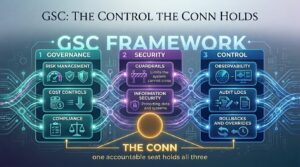
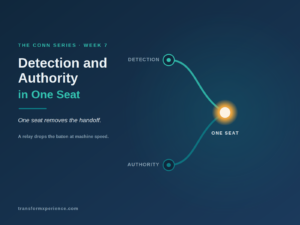
The gap does not need another artifact, another dashboard, or another title. It needs a named, standing accountability for the running system, held by someone close enough to run it, watched on a cadence, and never allowed to grow unobserved. That is a different model from the one the market defaults to. It is the difference between buying a plan and owning an operation. We build it, you own it, you run it.
This is also why a one-time cleanup does not hold. Drift is not an event you resolve. It is a condition your organization generates continuously by being adaptive. Put automation on top of that condition and it compounds on a faster timer, which is where this series goes next. A cleanup treats a permanent condition as a single event, and the gap reopens the moment the effort ends.
The Point
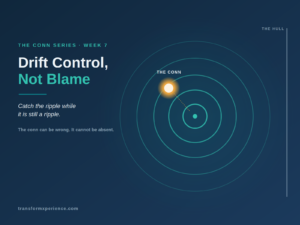
The gap between the system you documented and the system you run is real, it is growing, and in most organizations it belongs to no one. That is not a failure of your people. It is a hole in the org chart, in the exact shape of a responsibility no one thought to assign, because at launch it did not exist yet.
Naming the gap is the necessary first move. Naming who holds it is the harder one, and it is where this season is headed. For now, sit with the uncomfortable version of the question. In your organization, right now, who owns the drift? If you cannot answer without the room going quiet, you have found the seat that is empty.
Find the seams where ownership disappears
The Program Alignment Assessment Checklist walks you through where accountability evaporates across your programs and what it is costing you. In about fifteen minutes it gives you a count you probably cannot produce today: how many of your critical programs have no one owning the drift. Download it from the TransformXperience Insights hub, and subscribe to The Transformation Pulse for the ongoing case on who has to hold the line.