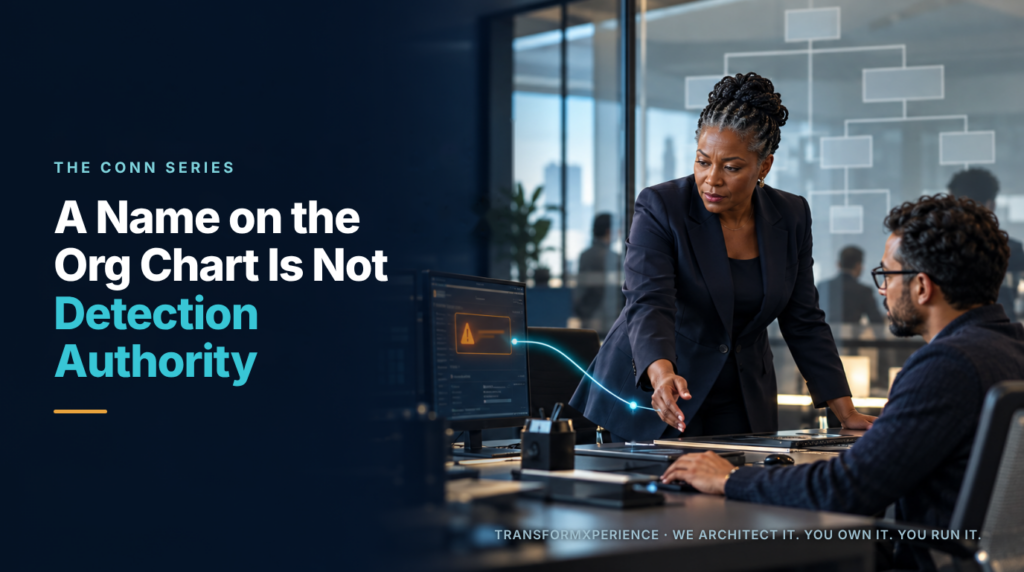
The seat carries the name and the instrument. A title alone carries neither.
Name the person who stops your most important automation the moment it drifts past the line. Not the policy. Not the committee. The person.
Many leadership teams can answer that quickly. There is a name on the org chart: a title, a box, a reporting line. The harder question is whether that person would know in time, and whether they could act when they did.
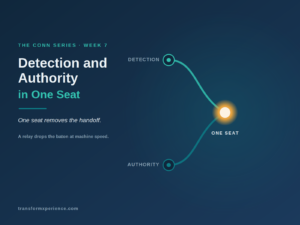
The conn is the named, accountable human who holds detection and authority in one seat, and who runs the operating model against drift. The definition does not say named and titled. It says named, accountable, and holding detection and authority in one seat. A title can supply the name. It cannot supply the other two.
Detection authority, as we use it, means two things held together: material drift reaches the seat in time, and the seat holds pre-agreed authority to act on it. It is not the authority to execute every fix.
What a Title Gives You
A title is useful. It tells the organization who to call, who signs, and who answers to the board. But a title is a statement about responsibility. Detection authority is a statement about operation: the signal reaches this seat in time, and this seat can act on it.
In our experience, the two separate more often than leaders expect. Consider an illustrative pattern. An organization appoints a senior leader as accountable for its AI program. The model’s performance data flows to a vendor dashboard that someone reviews monthly. The authority to pause the workflow sits with an operations manager in another function. The authority to change a rule waits on the vendor’s release schedule. On paper, accountability is clear. In operation, the named leader learns about drift from a monthly report and holds none of the levers.
That is a name without the instrument. It reads well in a charter. It fails the first time the model drifts on a Tuesday afternoon.
A name tells you who answers. The instrument decides whether they can.
The Four Things a Real Seat Carries
TransformXperience (TXP) tests the seat, not the title. A real seat carries four things, and each one is observable.
- The signal. Material drift reaches this seat inside the window that matters for this automation, without waiting for a report cycle. The sensing can be instrumented; the seat owns what the signal means.
- The standing. The seat holds pre-agreed authority to invoke defined actions: pause, contain, restore a known-good state, or escalate, when defined conditions are met. Within those pre-agreed limits, it acts without asking permission in the moment. Decisions outside them, including those that require clinical, compliance, or executive authorization, go to the people who hold that authority. The teams that own the affected systems execute the changes.
- The instrument. The instrument is the seat’s connection to the GSC mechanisms, Governance, Security, and Control: the signals it reads and the controls it can invoke. Those mechanisms are connected to the seat, so the person who sees the drift can invoke the response through the teams that own each control, and confirm it worked.
- The handover. The seat has a named backup and a recorded handover, so it is never vacant and never in doubt through vacations, rotations, and incidents.
A seat with the name and none of the four is a figurehead. A seat with the signal and no standing is a witness. A seat with standing and no signal acts on old news. The conn holds all four.
Why the Common Fixes Fall Short
TXP defines the seat by what it can see and do, implements the connections that make it work, and stays accountable for the parts working together until your team takes over and runs it. Leaders who sense this gap often reach first for three familiar fixes. Each is useful. None, on its own, establishes the seat in operation.
A new title. A Chief AI Officer may be the right accountable leader for certain decisions. The title establishes a point of responsibility, but it does not automatically connect that leader to the signals, decision rights, and response capabilities required in operation. Those connections must be established deliberately.
A responsibility matrix. A RACI chart records who is responsible, accountable, consulted, and informed. It is a useful map of intent. It does not route a signal, grant a pause, or connect a control. It describes the seat; it does not equip it.
A committee charter. A committee sets policy and reviews performance, and it meets on a calendar. Between meetings, an automation can run a drifted rule across thousands of cases.
The title stays. The matrix stays. The committee keeps its role. What changes is that the name on the chart now holds the signal, the standing, the instrument, and the handover.
Test Your Own Seat
Pick one automation that can move your business and run four checks. When it last drifted, or when you last tested a drift scenario, who saw the signal first, and how long after it started? Could that same seat invoke a pause or a return to the known-good state without convening anyone? Once the response ran, did anyone verify that recovery held before normal operation resumed? And if that person is out today, who holds the seat, and is that written down?
If the answers point to one seat, inside the window, with verified recovery and a named backup, you have a conn. If they point to a title and a meeting, you have a name on the org chart.
Does Your Named Owner Hold the Instrument?
If your checks pointed to a title and a meeting, start with a free 30-minute conversation. We will talk through how drift would reach your named owners today, what they could do about it, where the signal and the authority come apart, and whether there is a fit.
Before we talk, Decision Seat Placement is a six-question check of where a decision sits today.