By Michelle McKinney, CEO and Founder, TransformXperience LLC
Reading time: 10 minutes
In the previous posts in our Mastering Delivery series, we covered the hidden costs of program misalignment and the seven symptoms that tell you your program is bleeding budget. If you recognized three or more of those symptoms, you already know you have a problem.
This post is about the fix. Not a theoretical framework from a textbook. A working model built from 14 enterprise engagements across healthcare, aviation, financial services, hospitality, government, payment processing, manufacturing, and telecom. A model refined over 27 years and pressure-tested in programs ranging from $10 million to $85 million.
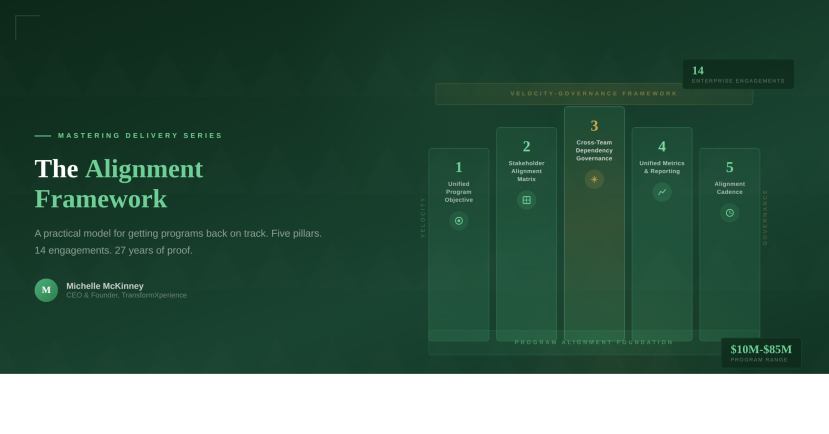
I call it the Velocity-Governance Framework. If you have read our blog post Orchestrating a Unified Digital Vision, you have already seen the philosophy behind this approach. This post is the operational implementation. It balances two forces that most organizations treat as opposing: the speed to deliver value (velocity) and the discipline to manage risk and alignment (governance). Get the balance wrong in either direction and the program suffers. Too much governance creates bureaucracy. Too little creates chaos. The framework finds the right tension for your program’s complexity and risk profile.
Why Most Alignment Frameworks Fail
Before I walk through the model, let me explain why the standard approaches do not work.
They are too abstract. A framework that says ‘align strategy to execution’ without telling you how is useless. Every PMO leader already knows that alignment matters. What they need is the specific mechanism. Who makes the decision? How often? What happens when teams disagree?
They assume a clean start. Most alignment frameworks are designed for programs that are just beginning. They do not account for the reality that most PMO leaders face: programs already in flight, with existing governance structures (even dysfunctional ones), established team dynamics, and political relationships that cannot be ignored.
They underestimate stakeholder complexity. A framework that works for a single-team project fails for a multi-workstream program with 5 executive stakeholders, 3 vendor teams, and cross-departmental dependencies. The governance model has to scale with the complexity.
The Velocity-Governance Framework addresses all three. It is specific enough to implement. It works for programs already in motion. And it scales across complexity levels.
The Five Pillars of Program Alignment
Pillar 1: Unified Program Objective
This sounds basic. It is not. In most misaligned programs, each team has a different interpretation of the program objective. IT thinks it is about technology modernization. Operations thinks it is about efficiency. The business unit thinks it is about customer experience. All three are partially right. None have the complete picture.
The unified program objective is a single statement that every team can trace their work back to. It is written in business outcome terms, not technical terms. And it is validated with every executive stakeholder before the alignment process begins.
How it worked at Kaiser Permanente: The $20 million+ digital transformation programs required Board of Directors level technology modernization. The unified objective had to bridge clinical outcomes, IT infrastructure, Azure Cloud migration, and AI/ML implementation. Without one statement that connected all four dimensions, each group would have optimized in isolation. The unified objective became the filter through which every trade-off was evaluated.
Pillar 2: Stakeholder Alignment Matrix
Every program has stakeholders. Most programs do not have a clear map of who has decision authority over what. The Stakeholder Alignment Matrix defines three things for every key decision area:
- Who decides (single decision maker, not a committee).
- Who must be consulted (input required before the decision).
- Who is informed (notified after the decision, no veto power).
This is not RACI. RACI is too generic and rarely enforced. The Stakeholder Alignment Matrix is specific to the decision categories that matter in your program: scope changes, resource allocation, vendor selection, architecture decisions, timeline modifications, and risk escalation.
How it worked at IHG: The $19 million+ global reservations re-platform had stakeholders across digital channels, voice channels, security, infrastructure, and global operations. Without a clear decision matrix, every scope change triggered a round-robin of approvals that could take weeks. The Stakeholder Alignment Matrix reduced decision latency by defining exactly who owned each category. Zero security incidents. On-track delivery across both channels.
Pillar 3: Cross-Team Dependency Governance
Dependencies are the silent killer of program timelines. In aligned programs, they are mapped at initiation, tracked weekly, and updated whenever scope changes. In misaligned programs, they are discovered when something breaks.
Cross-Team Dependency Governance requires three things:
- A dependency register that lives at the program level, not buried in individual project plans.
- A weekly dependency review meeting where each team reports on incoming and outgoing dependencies.
- A mandatory impact assessment for any change that touches a dependency point.
How it worked at Travelport: Managing a $50 million+ application portfolio with mission-critical systems, hidden dependencies were the biggest risk. SAFe methodology alignment gave us the ceremony structure. But the real breakthrough was the dependency register that connected all workstreams into a single visibility layer. Teams could see exactly who depended on their deliverables and when. Surprises dropped to near zero.
If your organization is also scaling Agile across multiple teams, our blog post Agile at Scale covers the methodology considerations that complement this dependency governance approach. (/agile-at-scale-why-84-of-enterprise-transformations-fail-and-how-to-beat-the-odds/)
Pillar 4: Unified Metrics and Reporting
If each team reports different metrics, the program has no single source of truth. Unified metrics do not mean eliminating team-level KPIs. They mean establishing a program-level dashboard that translates every team’s contribution into business outcomes.
The dashboard should answer three questions at all times: Are we on budget? Are we on schedule? Are the business outcomes we promised still achievable?
How it worked at Norfolk Southern: Early in my career, I managed a $42 million data center migration with 60 resources across 5 platforms. Zero critical incidents. That result came from unified visibility. Every team. Every platform. Every dependency. One dashboard that showed progress in terms the executive sponsor cared about: risk to the business, not technical task completion.
What construction reinforced: In my general contracting business, the investor does not want to know how many studs are framed. They want to know if the house will be ready for the buyer on the date they committed. IT executives are no different. Translate technical progress into business impact. Every time.
Pillar 5: Alignment Cadence
Alignment is not a one-time activity. It is a cadence. A rhythm of touchpoints that keeps the program connected as it evolves.
The cadence includes three levels:
Weekly: 15-minute program alignment sync. Each workstream lead reports: what shipped, what is blocked, and what dependencies changed. No slides. No status reports. Just verbal updates with action items captured in real time.
Biweekly: 30-minute executive briefing. Financial status, risk summary, and one decision that needs executive input. Always one decision. If you bring five decisions to a biweekly, none of them get resolved.
Monthly: 60-minute steering committee. Full program health review. Budget forecast update. Risk register review. Strategic alignment check: is the program still delivering what the business needs, or have conditions changed?
This cadence scales. For smaller programs, combine the weekly and biweekly. For larger programs, add daily standups at the workstream level that feed into the weekly sync.
Applying the Framework to a Program Already in Motion
Most alignment frameworks assume you are starting from scratch. You are not. You have a program with established teams, existing governance (even if it is not working), and political dynamics that you need to navigate.
Here is how to apply the five pillars without blowing up what already exists.
Week 1-2: Diagnose. Use the Program Alignment Assessment Checklist to score your current state. Identify which pillars are weakest. You do not need to fix everything at once. Start with the pillar that is causing the most visible pain.
Week 3-4: Align the objective. Get every executive stakeholder in a room (or on a call) and validate the unified program objective. This is often the hardest step because it surfaces disagreements that have been avoided. That is the point. Better to surface them now than discover them at integration testing.
Week 5-8: Implement governance. Deploy the Stakeholder Alignment Matrix. Establish the dependency register. Launch the alignment cadence. Start with the weekly sync and add the biweekly executive briefing in week 6.
Week 9-12: Measure and adjust. Track leading indicators. Decision velocity. Dependency surprise rate. Rework frequency. Stakeholder satisfaction. These will tell you whether the framework is working before the lagging indicators (budget, timeline) catch up.
The Bottom Line
Programs do not fail because people are not working hard enough. They fail because the work is not connected. The Velocity-Governance Framework is the connection layer that turns individual project execution into coordinated program delivery.
It is not complicated. Five pillars. A weekly cadence. Clear decision authority. Visible dependencies. Unified metrics. The difficulty is not understanding it. The difficulty is having the discipline to implement it consistently, especially when the program is under pressure and every instinct says to skip the alignment meeting and just ship something.
In my construction business, I learned that skipping the alignment step always costs more than doing it. A missed coordination meeting between the electrician and the plumber means opening the wall twice. A missed dependency between the permit office and the framing crew means idle workers. In IT, the same principle applies. The cost of alignment is always less than the cost of misalignment.
Always.
Continue the Mastering Delivery Series
If you missed the earlier posts, start with The Hidden Costs of Program Misalignment: What Your Budget Reports Won’t Tell You for the financial case (/the-hidden-costs-of-program-misalignment-why-your-budget-is-bleeding/), then Symptoms of Misaligned Programs: 7 Warning Signs Your PMO Is Bleeding Budget for the diagnostic checklist (/symptoms-of-misaligned-programs/). For the leadership dimension of alignment, read Building PMO Credibility with the C-Suite: How to Earn Executive Trust Before You Need It. (/building-pmo-credibility-c-suite/)
Related Reading from Our Blog
These published articles on transformxperience.com connect to concepts in this framework:
On digital strategy alignment: Orchestrating a Unified Digital Vision covers the strategic thinking that precedes framework implementation. Start here if your organization has not yet defined what ‘digital transformation’ means for your business. (/orchestrating-a-unified-digital-vision-forging-ahead-from-fragmented-it/)
On scaling Agile: Agile at Scale addresses the methodology decisions that affect how the Velocity-Governance Framework integrates with your delivery approach. (/agile-at-scale-why-84-of-enterprise-transformations-fail-and-how-to-beat-the-odds/)
On data foundations: Data Governance Done Right and The Modern Data Foundation cover the data governance infrastructure that Pillar 4 (Unified Metrics) depends on. (/data-governance-done-right-building-trust-compliance-in-your-data/ and /the-modern-data-foundation-mastering-data-warehousing-migration/)
On legacy modernization: Beyond Legacy: Modernizing Your IT Backbone is relevant if your alignment challenges are rooted in technical debt and aging infrastructure. (/beyond-legacy-modernizing-your-it-backbone-for-future-growth/)
On rescue situations: From Red to Green: Why 84% of Rescues Fail covers what to do when alignment intervention alone is not enough and the program needs full rescue. (/from-red-to-green-why-84-of-program-rescues-fail/)
About the Author
Michelle McKinney is the CEO and Founder of TransformXperience LLC, where she brings enterprise-level PMO capabilities to mid-market companies. The Velocity-Governance Framework was developed across 14 enterprise engagements spanning 12+ industries over 27 years. Key framework applications include: Kaiser Permanente ($20M+ healthcare digital transformation), Delta Air Lines ($32M aviation portfolio, 80% risk reduction), Travelport ($50M+ travel technology, SAFe alignment), SunTrust Bank ($15M financial services rescue), IHG ($19M+ hospitality re-platform), Gwinnett County ($10M government PMO buildout), and 6 years at Accenture managing $85M+ across multiple Fortune 500 clients. Her unique differentiator: 20 years simultaneously building a general contracting business from zero to $650,000+, applying the same alignment discipline to physical construction that she brings to digital transformation.