By Michelle McKinney, CEO and Founder, TransformXperience LLC
Reading time: 9 minutes
Here is a truth most PMO leaders learn the hard way. Executive sponsorship is not given. It is earned. And it is earned long before you need it.
I have watched PMOs with brilliant methodologies get shut down because the C-Suite never understood their value. I have also seen PMOs with basic toolsets thrive because their leader knew how to speak the language of business outcomes, not project metrics.
The difference is credibility. And credibility is not built in a crisis. It is built in the quiet months when nobody is paying attention. When the PMO is delivering small wins, making executives look good, and creating visibility that leadership did not have before.
After 27 years of building, rebuilding, and transforming PMOs across Fortune 500 companies, Big 4 consulting firms, and mid-market organizations, I can tell you that the PMOs that survive budget cuts and organizational restructures all share the same trait. Their leaders invested in executive relationships before they needed them.
This post is part of our Mastering Delivery series on program alignment. The companion posts cover the hidden costs of program misalignment, the seven symptoms of misaligned programs, and the alignment framework itself. This post addresses the leadership dimension: how to build the executive credibility that makes alignment possible in the first place.
If you have read our blog post The Boardroom’s Digital Edge, you already understand how technology decisions are being made at the board level. This post is about making sure your PMO has a seat at that table. (/the-boardrooms-digital-edge-secure-decision-making-in-the-modern-era/)
The Executive Sponsorship Trap
Most PMO literature tells you to ‘secure executive sponsorship’ as step one. This is backward. If you need to secure sponsorship, you have already lost the game.
Executive sponsorship that you have to ask for is fragile. It disappears the moment priorities shift, budgets tighten, or a new CIO arrives with a different agenda. Sponsorship that you earn through demonstrated value is durable. It survives leadership transitions because the outcomes speak for themselves.
What I saw at Gwinnett County Government: When I was brought in, there was no PMO. A $10 million IT portfolio with zero program-level governance. No executive was asking for a PMO. Nobody was sponsoring one. I built it from scratch by delivering results first. Vendor management frameworks that saved money. Reporting that gave leadership visibility they never had. Within months, the PMO was not just tolerated. It was valued. Project failure rates dropped 75%. The frameworks I built are still used today for training new staff.
The lesson: do not ask for permission to be credible. Be credible first. The sponsorship follows.
What Executives Actually Care About
PMO leaders often make the mistake of leading with methodology. Agile maturity levels. CMMI scores. Velocity metrics. Earned value analysis. These mean nothing to a CFO who wants to know why the digital transformation is six months late and $3 million over budget.
Executives care about three things:
Financial outcomes. Did the program deliver within budget? Did it generate the ROI the business case promised? Where is the money going?
Risk to the business. What could go wrong? How likely is it? What is the plan if it happens?
Speed to value. When will the organization start seeing returns? Not when will the project be done. When will the business benefit begin?
If your PMO reporting does not lead with these three dimensions, you are speaking a language that executives do not use. And they will tune you out regardless of how rigorous your methodology is. Our blog post Why IT Projects Fail: 7 Warning Signs Your PMO Is Missing covers the most common patterns that erode executive confidence. (/why-it-projects-fail-warning-signs/)
Building Credibility Through Results, Not Presentations
Start with a Quick Win
The fastest way to build PMO credibility is to solve a visible problem that executives already know about. Not a methodology rollout. Not a governance framework document. A specific problem with a measurable outcome.
What I did at Accenture: Managing an $85 million portfolio over 6 years with 30+ resource teams, the credibility was built on consistent delivery. 35% average organizational cost savings across all clients. 22% average process improvements. These were not presentations about what we planned to do. They were documented results. Every new engagement started with the track record from the previous one.
What I did at Ernst & Young: The $25 million RTF Program was lagging when I was brought in. The program was behind schedule and at risk of missing regulatory stage gates. We rescued it. Passed all stage gates. Met the budget. That result became the credibility foundation for everything that followed.
Make Hidden Costs Visible
One of the most powerful credibility moves a PMO leader can make is showing the C-Suite money they did not know they were losing.
Every organization has hidden costs. Duplicate development across teams. Rework from misaligned requirements. Resource over-allocation that nobody tracks at the portfolio level. When you quantify these and present them in financial terms, executives notice.
What I did at Delta Air Lines: When I quantified the impact of resource over-allocation and risk mismanagement across the $32 million portfolio, the numbers were eye-opening. An 80% reduction in risk and 90% reduction in resource over-allocation translated to real financial outcomes that the leadership team could see. That visibility is what earned ongoing executive support.
For a deeper dive into how to find and quantify these hidden costs, read our companion post The Hidden Costs of Program Misalignment: What Your Budget Reports Won’t Tell You. (/the-hidden-costs-of-program-misalignment-why-your-budget-is-bleeding/)
Deliver Bad News Early
Nothing destroys PMO credibility faster than surprises. If a program is going to miss a deadline, the C-Suite needs to hear it from you first. Not from a vendor. Not from a business stakeholder. Not in a quarterly review when it is too late to course-correct.
Early transparency builds trust. Executives do not expect perfection. They expect honesty. A PMO leader who raises a risk flag at 20% completion and presents a mitigation plan earns far more respect than one who hides the problem until 80% completion and has no plan.
What construction taught me: In 20 years of running a general contracting business alongside my consulting career, I learned that hiding problems from investors is a career-ending move. When a permit stalls, you tell the investor immediately. When the timeline shifts, you present the revised plan the same day. When the inspection fails, you explain what happened and what the fix costs. No surprises. Ever. I brought that same discipline to executive communications in IT programs.
The Credibility Framework
Based on what has worked across 14 client engagements, here is the framework I use for building and maintaining C-Suite credibility.
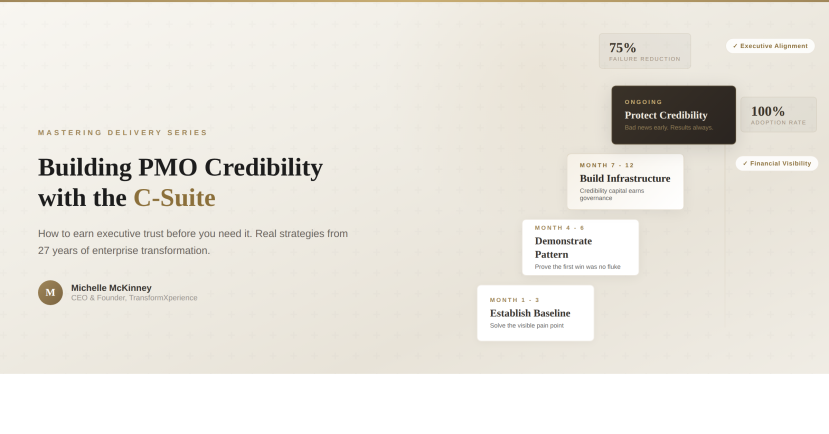
Month 1-3: Establish Baseline. Audit the current state. Identify the biggest visible pain point. Solve it. Document the before and after in financial terms. Share the results with executives in a 5-minute briefing, not a 30-slide deck.
Month 4-6: Demonstrate Pattern. Solve a second and third problem. Show that the first win was not a fluke. Begin weekly or biweekly executive briefings. Keep them to 10 minutes. Lead with financial outcomes and risks. Never lead with methodology.
Month 7-12: Build Infrastructure. Now you have credibility capital. Use it to implement governance frameworks, standardize reporting, and establish the processes that will scale. Executives will support structure they can see is built on results.
Ongoing: Protect Credibility. Deliver bad news early. Always over-communicate on risk. Never surprise an executive. And track every result the PMO delivers in financial terms so the value is always quantifiable.
What Kills PMO Credibility Fastest
Over-promising on timelines. If you are not confident in the date, say so. A realistic estimate with a range beats an aggressive date that you miss.
Leading with process instead of outcomes. Nobody in the C-Suite cares about your new intake process unless it reduces time-to-value. Show the outcome first. Explain the process only if asked.
Treating all projects equally. Not everything is strategic. The PMO that treats a $50,000 website redesign with the same governance as a $20 million digital transformation will frustrate everyone and deliver value to no one. Triage ruthlessly.
Avoiding accountability. If the PMO failed to catch a risk, own it. Explain what happened and what changed so it does not happen again. Accountability builds trust. Deflection destroys it.
Continue the Mastering Delivery Series
This post is part of our program alignment series. Start with The Hidden Costs of Program Misalignment: What Your Budget Reports Won’t Tell You for the financial case (/the-hidden-costs-of-program-misalignment-why-your-budget-is-bleeding/). Then read Symptoms of Misaligned Programs: 7 Warning Signs Your PMO Is Bleeding Budget for the diagnostic checklist (/symptoms-of-misaligned-programs/). When you are ready for the implementation model, The Alignment Framework: A Practical Model for Getting Programs Back on Track walks you through our five-pillar approach. (/the-alignment-framework/)
Related Reading from Our Blog
These published articles on transformxperience.com expand on themes in this post:
On boardroom technology leadership: The Boardroom’s Digital Edge covers how technology decisions are being made at the board level and why your PMO needs to speak that language. (/the-boardrooms-digital-edge-secure-decision-making-in-the-modern-era/)
On AI strategy for executives: AI & The Intelligent Enterprise: From Hype to ROI provides the framework for discussing AI investments with the C-Suite in ROI terms, not technical terms. (/ai-the-intelligent-enterprise-from-hype-to-roi/)
On cybersecurity as executive conversation: Cybersecurity as a Strategic Enabler reframes security from a cost center to a strategic differentiator. Relevant for PMO leaders presenting to risk-conscious boards. (/cybersecurity-as-a-strategic-enabler-protecting-your-digital-assets-for-future-growth/)
On PMO failure patterns: Why IT Projects Fail: 7 Warning Signs Your PMO Is Missing covers the warning signs that erode C-Suite confidence in your PMO. (/why-it-projects-fail-warning-signs/)
On measuring transformation ROI: Actionable Intelligence covers how to build the reporting infrastructure that translates PMO activity into business language executives understand. (/actionable-intelligence-transforming-big-data-into-strategic-insights/)
About the Author
Michelle McKinney is the CEO and Founder of TransformXperience LLC. She has built and rebuilt PMO credibility at the highest levels of enterprise leadership. At Accenture (2007-2013), she managed an $85 million portfolio as Senior Manager, delivering 35% cost savings and 22% process improvements across Fortune 500 clients including the MTA NYC transit system. At Ernst & Young, she rescued a $25 million healthcare program, passing all regulatory stage gates. Her named client portfolio includes Kaiser Permanente ($20M+ digital transformation), Delta Air Lines ($32M portfolio), IHG ($19M+ global re-platform), and Gwinnett County Government (built PMO from scratch, 75% failure reduction). Earlier in her career, she managed a $42 million data center migration at Norfolk Southern with 60 resources across 5 platforms and zero critical incidents. She also built a general contracting business from zero to $650,000+ over 20 years, proving that credibility is earned through results in any industry.