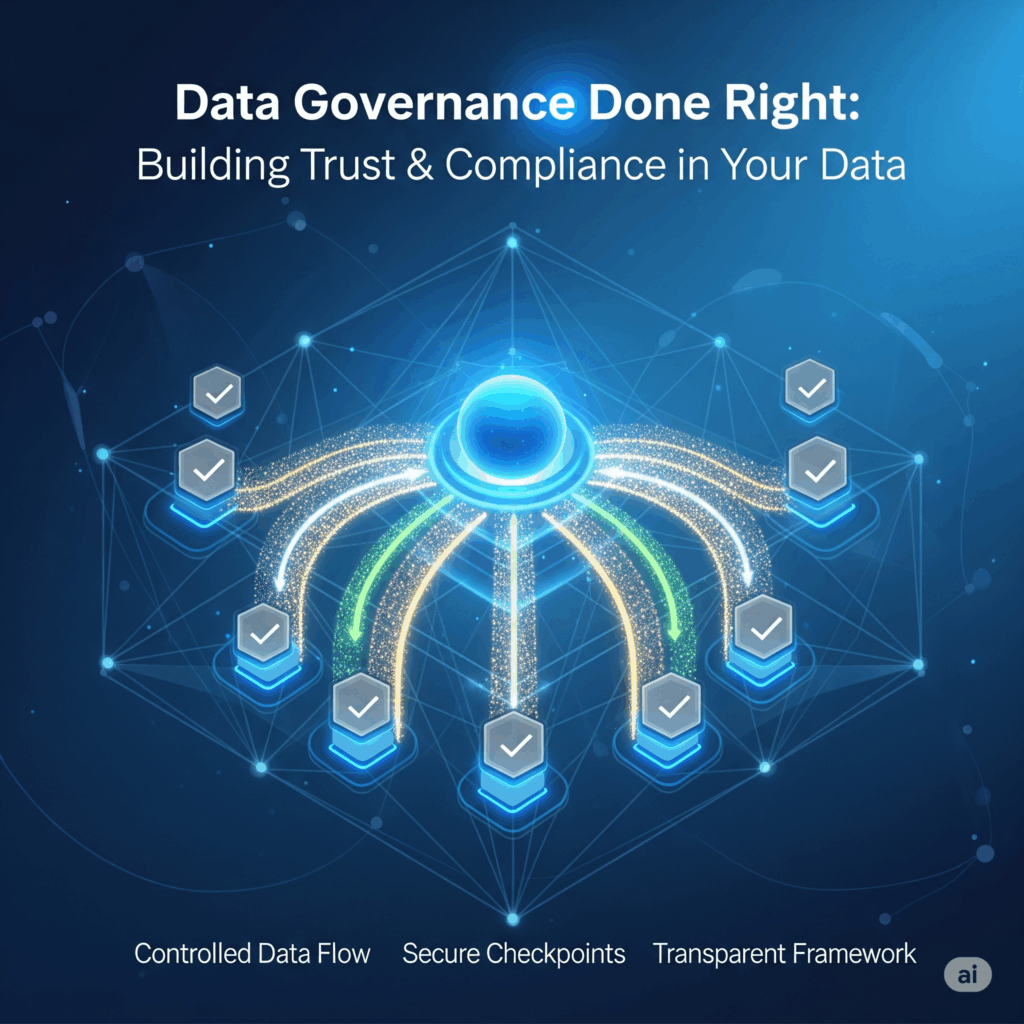
In an era where data breaches make headlines and regulatory scrutiny intensifies, organizations face a critical challenge: how do you harness the power of data while maintaining absolute trust in its accuracy, security, and compliance? The answer lies in robust data governance—a comprehensive framework that transforms chaotic data landscapes into reliable, compliant, and strategically valuable assets.
Data governance isn’t just about compliance checkboxes or IT policies. It’s about creating an organizational culture where data is treated as a strategic asset, protected with the same rigor as financial resources, and managed with clear accountability and purpose. When done right, data governance becomes the foundation that enables innovation while mitigating risk.
The Modern Data Governance Imperative
Today’s organizations operate in a complex regulatory environment where data protection laws like GDPR, CCPA, and industry-specific regulations create both opportunities and obligations. Simultaneously, the explosion of data sources—from IoT devices to social media interactions—has created unprecedented volumes of information that can drive competitive advantage or, if mismanaged, create significant liability.
The stakes have never been higher. Poor data governance can result in regulatory penalties, reputational damage, and lost business opportunities. Conversely, organizations with strong data governance frameworks can move faster, make better decisions, and build deeper customer trust through demonstrated data stewardship.
The Cost of Poor Data Governance
The financial impact of inadequate data governance extends far beyond regulatory fines. Organizations commonly face challenges, including duplicated customer records leading to poor customer experiences, inconsistent reporting that undermines decision-making confidence, data quality issues that compromise analytics initiatives, and integration delays that slow digital transformation efforts.
More critically, poor data governance creates a culture of distrust around data, where business users question the reliability of reports and analytics, leading to decision-making paralysis and missed opportunities.
Foundational Elements of Effective Data Governance
Data Quality Management
Data quality forms the bedrock of any successful governance program. This encompasses accuracy, completeness, consistency, timeliness, and validity across all data assets. Effective data quality management requires both preventive measures that stop poor quality data at its source and corrective processes that identify and remediate existing issues.
Modern data quality frameworks leverage automated profiling tools to continuously monitor data health, implement business rules that enforce quality standards, and provide clear metrics that demonstrate improvement over time. The key is creating processes that are embedded in daily operations rather than periodic cleanup exercises.
Master Data Management (MDM)
Master Data Management creates the “single source of truth” for critical business entities like customers, products, suppliers, and locations. MDM ensures that regardless of where data originates or how it’s accessed, users work with consistent, accurate, and complete information.
Successful MDM implementations require careful attention to data modeling, establishing clear hierarchies and relationships between entities, implementing robust matching and deduplication algorithms, and creating governance processes that maintain data quality over time. The goal is to ensure that when someone references “Customer ABC,” everyone in the organization is talking about the same entity with the same attributes.
Reference Data Management
While master data focuses on core business entities, reference data management handles the standardized values that categorize and classify information throughout the organization. This includes country codes, product categories, status values, and other controlled vocabularies that ensure consistency across systems and processes.
Effective reference data management establishes centralized repositories for these standardized values, implements approval workflows for changes, and provides clear lineage tracking to understand the impact of modifications across the enterprise.
Building a Comprehensive Governance Framework
Organizational Structure and Accountability
Successful data governance requires clear organizational structures that define roles, responsibilities, and decision-making authority. This typically includes a data governance council that provides strategic oversight, data stewards who manage day-to-day quality and compliance for specific domains, and data custodians who handle technical implementation and maintenance.
The framework must also establish clear escalation paths for data-related issues, define approval processes for policy changes, and create mechanisms for cross-functional collaboration on data initiatives.
Policies and Standards Development
Comprehensive data governance frameworks require detailed policies that address data classification, access controls, retention requirements, and privacy protection. These policies must be practical and enforceable, with clear guidelines for implementation and compliance monitoring.
Standards development covers technical aspects like data formats, naming conventions, and integration patterns, as well as operational procedures for data handling, incident response, and change management.
Technology Infrastructure and Tools
Modern data governance relies heavily on technology platforms that can automate policy enforcement, monitor compliance, and provide visibility into data usage patterns. This includes data catalogs that help users discover and understand available data assets, lineage tracking tools that show how data flows through systems and transformations, and access management platforms that enforce security policies.
The technology infrastructure must integrate seamlessly with existing systems while providing the flexibility to adapt to changing requirements and emerging technologies.
Compliance and Risk Management
Regulatory Compliance Strategy
Different industries and geographies impose varying requirements for data protection, retention, and usage. A robust governance framework must accommodate these diverse requirements while maintaining operational efficiency.
This involves mapping data assets to applicable regulations, implementing controls that ensure compliance throughout the data lifecycle, establishing audit trails that demonstrate adherence to requirements, and creating processes for responding to regulatory inquiries or data subject requests.
Industry-Specific Governance Challenges
Different industries face unique governance requirements that must be addressed within the overall framework. Financial services organizations must navigate SOX compliance, Basel III requirements, and anti-money laundering regulations while maintaining data lineage for regulatory reporting. Healthcare organizations balance HIPAA privacy requirements with research and analytics needs, often requiring sophisticated consent management and de-identification processes. Retail and e-commerce companies must handle PCI compliance for payment data while managing customer privacy preferences across multiple touchpoints and channels.
Manufacturing organizations increasingly manage IoT sensor data and supply chain information with varying retention and quality requirements. At the same time, pharmaceutical companies must maintain extensive data integrity controls for FDA validation and clinical trial compliance.
Privacy and Security Integration
Data governance and security must work hand-in-hand to protect sensitive information while enabling legitimate business use. This requires implementing data classification schemes that identify sensitive information, establishing access controls based on the principle of least privilege, and monitoring data usage to detect potential violations or anomalies.
Privacy considerations must be embedded throughout the data lifecycle, from collection and processing to storage and disposal, ensuring that applicable laws and organizational policies handle personal information.
Risk Assessment and Mitigation
Effective governance frameworks include regular risk assessments that identify potential vulnerabilities in data handling processes. This encompasses both technical risks, like system failures or security breaches, and operational risks, like inadequate training or unclear procedures.
Risk mitigation strategies must be proportionate to the identified threats while maintaining business agility and user productivity.
Implementation Strategies for Success
Phased Approach to Governance Implementation
Implementing comprehensive data governance across an entire organization simultaneously is rarely successful. Instead, practical implementations typically follow a phased approach that starts with high-value, high-risk data domains and gradually expands coverage over time.
At TransformXperience, we help organizations identify the optimal starting points based on business value, regulatory requirements, and technical feasibility. This might involve focusing initially on customer data for GDPR compliance, financial data for regulatory reporting, or product data for supply chain optimization.
Change Management and User Adoption
Data governance success depends heavily on user adoption and cultural change. This requires comprehensive training programs that help users understand not just the “what” but the “why” behind governance requirements, clear communication about benefits and expectations, and ongoing support that allows users to integrate governance practices into their daily workflows.
Successful implementations also include feedback mechanisms that allow users to suggest improvements and report issues, creating a sense of ownership and continuous improvement around governance practices.
Measuring Success and Continuous Improvement
Effective data governance programs establish clear metrics that demonstrate value and track progress over time. Key performance indicators include data quality scores (accuracy rates above 95%, completeness metrics by domain), compliance metrics (audit pass rates, regulatory response times under 48 hours), operational efficiency measures (time-to-insight reduction, data search and discovery speed), and business impact assessments (revenue attribution from improved data quality, cost savings from eliminated duplicates).
Regular review and optimization ensure that governance frameworks evolve with changing business needs, regulatory requirements, and technological capabilities.
Technology Enablers and Best Practices
Modern Data Catalog Implementation
Data catalogs serve as the central hub for data discovery and understanding, providing users with comprehensive information about available data assets, their quality characteristics, and usage restrictions. Leading platforms like Collibra, Informatica CLAIRE, and Alation offer enterprise-grade capabilities, while emerging solutions like DataHub and Apache Atlas provide open-source alternatives for organizations seeking greater customization.
Modern catalogs use automated discovery and profiling to maintain up-to-date inventories while providing collaborative features that enable crowd-sourced documentation and knowledge sharing.
Automated Policy Enforcement
Manual policy enforcement is neither scalable nor reliable in modern data environments. Successful governance frameworks leverage automation to enforce access controls, monitor data usage, validate quality rules, and trigger alerts when violations occur.
This automation must be carefully balanced with business flexibility, providing mechanisms for handling legitimate exceptions while maintaining overall control and compliance.
Integration with DevOps and DataOps
Data governance must integrate seamlessly with modern software development and data pipeline operations. This means embedding governance controls into CI/CD processes, providing APIs that enable programmatic access to governance metadata, and creating workflows that support agile development while maintaining compliance requirements.
The Business Impact of Effective Data Governance
Enhanced Decision-Making Confidence and Data Monetization
When business users trust the data they’re working with, they can make decisions more quickly and confidently. This trust comes from knowing that data has been validated, that definitions are consistent across the organization, and that quality issues are identified and addressed proactively.
Organizations with strong data governance report faster time-to-insight, reduced time spent on data validation and reconciliation, and increased adoption of analytics and business intelligence tools across the organization. More strategically, well-governed data becomes a monetizable asset through data product offerings, partnership opportunities, and enhanced customer experiences. Companies can confidently package and sell data insights, enter into data-sharing agreements with partners, and develop new revenue streams based on their data assets when governance frameworks ensure quality, compliance, and intellectual property protection.
Operational Efficiency and Cost Reduction
Effective data governance eliminates many of the inefficiencies associated with poor data management. This includes reducing time spent searching for data, eliminating duplicate data entry and maintenance, minimizing system integration issues, and streamlining compliance reporting processes.
The cumulative effect of these improvements can be substantial, often resulting in significant cost savings and productivity improvements across the organization.
Risk Mitigation and Competitive Advantage
Strong data governance doesn’t just mitigate risks—it creates competitive advantages. Organizations that can demonstrate strong data stewardship build greater customer trust, enabling new business models and partnerships. They can also move faster on new initiatives because they have confidence in their data foundation.
The Path to Governance Excellence
Implementing effective data governance requires more than technology—it demands strategic vision, organizational commitment, and deep expertise in both technical and business domains. Success depends on understanding the unique challenges and requirements of each organization while applying proven methodologies and best practices.
At TransformXperience, we specialize in helping organizations establish robust data governance frameworks that balance compliance requirements with business agility. Our approach recognizes that governance isn’t a destination but an ongoing journey that must evolve with changing business needs and regulatory landscapes.
We work with organizations to assess their current state, design governance frameworks that fit their specific requirements, implement the necessary technology and processes, and establish the organizational structures needed for long-term success. Our methodology ensures that governance becomes an enabler of business value rather than a bureaucratic burden.
Building for the Future
The most successful data governance implementations are designed with the future in mind. This means creating frameworks that can accommodate new data sources and types, adapt to changing regulatory requirements, and integrate with emerging technologies like artificial intelligence and machine learning.
It also means building governance capabilities that scale with organizational growth and change, maintaining effectiveness whether dealing with startup-sized data volumes or enterprise-scale complexity.
Conclusion
Data governance done right transforms organizations from reactive data managers to proactive data strategists. It creates the foundation for innovation while ensuring compliance, builds trust while enabling access, and provides control while maintaining agility.
The organizations that excel in data governance don’t just check compliance boxes—they create sustainable competitive advantages through superior data stewardship. They build cultures where data is valued, protected, and leveraged effectively to drive business success.
At TransformXperience, we understand that effective data governance is both an art and a science, requiring deep technical expertise combined with practical business insight. We help organizations navigate this complexity, establishing controls and processes that create reliable, compliant, and strategically valuable data ecosystems.
Ready to transform your data governance approach? Partner with TransformXperience to establish the controls and processes that will make your data a trusted strategic asset.
Please schedule a consultation today to discuss how we can help build trust and compliance into your data ecosystem.