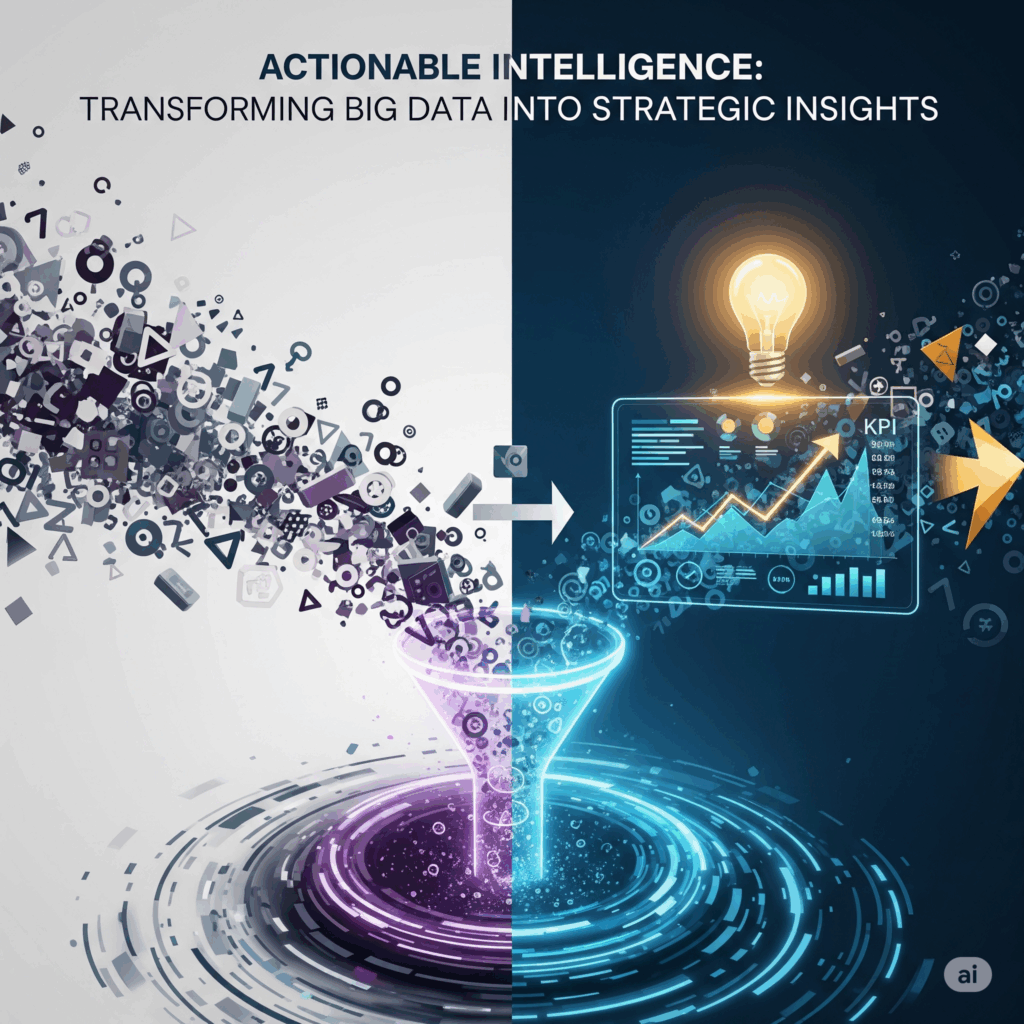
In today’s hyperconnected world, organizations generate data at an unprecedented scale. Every customer interaction, sensor reading, transaction, and operational process creates digital footprints that collectively form vast oceans of information. Yet despite this abundance, many organizations struggle with a fundamental challenge: how do you transform mountains of raw data into clear, actionable insights that drive real business value?
The answer lies not in collecting more data, but in developing sophisticated capabilities to capture, cleanse, analyze, and interpret information in ways that illuminate strategic opportunities and operational improvements. True competitive advantage emerges when organizations can move beyond basic reporting to predictive analytics, from reactive dashboards to proactive intelligence systems that guide decision-making and drive business growth.
The Big Data Challenge: Volume, Velocity, and Complexity
Modern enterprises face an exponential growth in data complexity that extends far beyond traditional structured databases. Customer behavior data streams in real-time from multiple touchpoints, IoT sensors generate continuous operational metrics, social media creates unstructured sentiment data, and business systems produce transactional information at scale.
This data explosion creates both unprecedented opportunities and significant challenges. Organizations that can effectively harness this information gain deep insights into customer preferences, operational inefficiencies, market trends, and competitive dynamics. However, those that fail to develop proper analytics capabilities find themselves drowning in information while starving for insight.
The Evolution from Data Collection to Intelligence
The journey from raw data to actionable intelligence requires sophisticated transformation processes that go far beyond simple data aggregation. It involves understanding data sources and their reliability characteristics, implementing robust capture and ingestion mechanisms, applying comprehensive cleansing and validation procedures, and developing analytics frameworks that can extract meaningful patterns and trends.
The most successful organizations recognize that data analytics is not a technological problem but a strategic capability that requires careful orchestration of people, processes, and technology to deliver sustainable competitive advantages.
Strategic Data Capture: Building the Foundation
Multi-Source Data Integration
Effective big data analytics begins with comprehensive data capture strategies that can handle diverse information sources and formats. This includes structured data from enterprise systems like ERP and CRM platforms, semi-structured data from APIs and web services, unstructured data from documents and social media, and streaming data from IoT devices and real-time interactions.
Modern data capture architectures must be designed for scalability and flexibility, accommodating both current data volumes and future growth while maintaining performance and reliability. This requires careful consideration of ingestion patterns, storage optimization, and processing workflows that can handle varying data velocities and volumes.
Real-Time vs. Batch Processing Strategies
Different business use cases require different data processing approaches. Real-time analytics enable immediate response to customer behaviors, fraud detection, and operational anomalies, while batch processing remains optimal for complex analytical workloads, historical trend analysis, and comprehensive reporting requirements.
Successful organizations develop hybrid architectures that can support both paradigms efficiently, ensuring that time-sensitive insights are available immediately while maintaining the depth and accuracy needed for strategic decision-making.
Data Quality at the Source
The foundation of actionable intelligence is high-quality data, which requires implementing quality controls at the point of capture rather than attempting to fix issues downstream. This involves validating data formats and ranges, implementing business rule checks, establishing data lineage tracking, and creating feedback mechanisms that improve source system data quality over time.
Comprehensive Data Cleansing: Ensuring Analytical Accuracy
Advanced Cleansing Methodologies
Raw data rarely arrives in a form suitable for immediate analysis. Effective data cleansing involves multiple sophisticated processes, including duplicate detection and resolution across disparate systems, standardization of formats and values, validation against business rules and constraints, and enrichment with additional contextual information.
Modern cleansing approaches leverage machine learning algorithms to identify patterns and anomalies that traditional rule-based systems might miss, while maintaining transparency and auditability in the cleansing process.
Data Standardization and Normalization
Creating consistent, reliable datasets requires standardizing information across different sources and systems. This includes normalizing naming conventions and formats, reconciling different coding schemes and classifications, establishing consistent temporal and geographic references, and creating unified customer and product identifiers across systems.
The goal is to create analytical datasets where similar entities are represented consistently, enabling accurate aggregation, comparison, and trend analysis across the entire data landscape.
Quality Metrics and Monitoring
Ongoing data quality requires continuous monitoring and measurement. Key quality dimensions include accuracy (correctness of data values), completeness (presence of required data elements), consistency (uniform representation across sources), timeliness (currency and freshness of information), and validity (conformance to defined formats and rules).
Establishing quality scorecards with specific targets (such as 99% accuracy for customer contact information or 95% completeness for product catalog data) provides clear benchmarks for improvement and helps maintain analytical reliability over time.
Advanced Analytics: From Description to Prediction
Descriptive Analytics Foundation
The analytics journey typically begins with descriptive analytics that help organizations understand what has happened in their business. This includes comprehensive reporting and dashboards, trend analysis and historical comparisons, performance metrics and KPI tracking, and segmentation analysis that reveals customer and operational patterns.
While descriptive analytics provide critical baseline understanding, they represent just the first step in developing comprehensive analytical capabilities that can drive strategic decision-making.
Predictive Analytics and Machine Learning
The real value of big data analytics emerges through predictive capabilities that help organizations anticipate future trends, customer behaviors, and business outcomes. This involves customer lifetime value modeling and churn prediction, demand forecasting and inventory optimization, risk assessment and fraud detection, and maintenance prediction for operational assets.
Modern predictive analytics leverage machine learning algorithms, including ensemble methods like random forests and gradient boosting, deep learning neural networks for complex pattern recognition, time series analysis for temporal predictions, and natural language processing for unstructured data insights.
Prescriptive Analytics for Decision Optimization
The most advanced analytics implementations go beyond prediction to provide specific recommendations for action. Prescriptive analytics combine predictive models with optimization algorithms to suggest the best course of action given particular constraints and objectives.
This might include pricing optimization based on demand elasticity and competitive dynamics, resource allocation recommendations for maximum efficiency, marketing campaign optimization across channels and segments, and supply chain optimization for cost and service level objectives.
Industry-Specific Analytics Applications
Retail and E-Commerce Intelligence
Retail organizations leverage big data analytics for customer journey analysis across digital and physical touchpoints, personalization engines that deliver relevant product recommendations, inventory optimization based on demand patterns and seasonal trends, and pricing strategies that maximize margin while maintaining competitiveness.
Advanced retail analytics also include market basket analysis for cross-selling opportunities, location analytics for store placement and layout optimization, and sentiment analysis from customer reviews and social media interactions.
Financial Services Analytics
Financial institutions use sophisticated analytics for credit risk modeling and portfolio optimization, algorithmic trading strategies based on market data analysis, fraud detection using real-time transaction monitoring, and regulatory compliance reporting with comprehensive audit trails.
Customer analytics in financial services focus on product affinity modeling, next-best-action recommendations, and lifecycle value optimization across multiple product relationships.
Manufacturing and Operations Intelligence
Manufacturing organizations implement analytics for predictive maintenance that minimizes downtime and extends asset life, quality control systems that identify defects early in production processes, supply chain optimization that balances cost and service levels, and energy management systems that optimize consumption while maintaining production targets.
Operations analytics also include workforce optimization, capacity planning, and process improvement identification through statistical analysis of production data.
Healthcare and Life Sciences Analytics
Healthcare organizations leverage analytics for patient outcome prediction and treatment optimization, clinical trial design and analysis, drug discovery and development acceleration, and population health management programs.
Healthcare analytics must balance analytical insights with strict privacy and security requirements, often requiring sophisticated anonymization and consent management capabilities.
Technology Infrastructure for Scale
Cloud-Native Analytics Platforms
Modern big data analytics increasingly relies on cloud-native platforms that provide scalability, flexibility, and cost-effectiveness. Leading solutions include Amazon Web Services (AWS) with services like Redshift, EMR, and SageMaker, Microsoft Azure with Azure Synapse, Data Factory, and Machine Learning Studio, Google Cloud Platform with BigQuery, Dataflow, and AI Platform, and hybrid solutions that combine cloud capabilities with on-premises infrastructure.
These platforms provide managed services that reduce infrastructure complexity while offering enterprise-grade security, compliance, and performance capabilities.
Open Source Analytics Ecosystems
Many organizations leverage open source technologies for flexibility and cost control. The Apache ecosystem includes tools like Spark for large-scale data processing, Kafka for real-time data streaming, Airflow for workflow orchestration, and Superset for data visualization.
Python and R remain the dominant languages for analytics development, with extensive libraries for machine learning, statistical analysis, and data manipulation.
Integration and API Strategies
Successful analytics implementations require seamless integration with existing business systems and processes. This involves developing APIs that provide programmatic access to analytical insights, embedding analytics capabilities directly into business applications, creating real-time alert and notification systems, and establishing data pipelines that maintain currency and accuracy.
Organizational Capabilities for Analytics Success
Building Analytics Teams and Skills
Developing sustainable analytics capabilities requires building teams with diverse skills, including data scientists who develop and validate analytical models, data engineers who build and maintain data infrastructure, business analysts who translate requirements into analytical solutions, and domain experts who provide industry knowledge and context.
Successful organizations also invest in training existing staff to become more data-literate, creating a culture where data-driven decision-making becomes the norm rather than the exception.
Governance and Model Management
As analytics capabilities mature, organizations need robust governance frameworks that ensure model accuracy and reliability, manage model lifecycle from development to retirement, maintain compliance with regulatory requirements, and provide transparency and explainability for decision-making processes.
Model governance includes version control, performance monitoring, bias detection and mitigation, and precise documentation of assumptions and limitations.
Change Management and User Adoption
The most sophisticated analytics capabilities provide no value if they’re not adopted and used effectively by business stakeholders. This requires comprehensive training programs that help users understand and interpret analytical insights, clear communication about the value and limitations of analytical models, and ongoing support that allows users to integrate insights into their decision-making processes.
Measuring Analytics Impact and ROI
Business Value Metrics
Effective analytics programs establish clear metrics that demonstrate business impact, including revenue growth attributable to analytical insights, cost savings from operational optimization, customer satisfaction improvements from personalization, and risk reduction from predictive capabilities.
Specific examples might include a 15% increase in customer retention from churn prediction models, a 20% reduction in inventory costs through demand forecasting, a 25% improvement in marketing ROI through customer segmentation, and a 30% reduction in equipment downtime through predictive maintenance.
Performance and Quality Indicators
Technical metrics ensure that analytics capabilities maintain reliability and accuracy over time. These include model accuracy and performance benchmarks, data quality scores and improvement trends, system performance and scalability measures, and user adoption and satisfaction ratings.
Regular monitoring and optimization ensure that analytics capabilities continue to deliver value as business conditions and requirements evolve.
The Path to Analytics Excellence
Transforming big data into actionable intelligence requires more than technology—it demands strategic vision, organizational commitment, and deep expertise in both analytical methods and business domains. Success depends on understanding the unique challenges and opportunities within each organization while applying proven methodologies and best practices.
At TransformXperience, we specialize in helping organizations develop comprehensive analytics capabilities that transform raw data into strategic insights and competitive advantages. Our approach recognizes that analytics is not a one-time project but an ongoing capability that must evolve with changing business needs and technological opportunities.
We work with organizations to assess their current analytical maturity, design analytics architectures that support both current needs and future growth, implement the necessary technology and processes for reliable data capture and analysis, and establish the organizational capabilities needed for sustained analytics success.
Our methodology ensures that analytics investments deliver measurable business value while building the foundation for continued innovation and growth.
Future-Proofing Analytics Capabilities
Emerging Technologies and Trends
The most successful analytics implementations are designed to accommodate emerging technologies and changing business requirements. This includes artificial intelligence and machine learning automation, edge computing for real-time analytics, augmented analytics that democratize insights across the organization, and conversational interfaces that make analytics accessible to non-technical users.
Organizations must also prepare for evolving privacy regulations, new data sources and types, and changing customer expectations around personalization and service delivery.
Continuous Innovation and Improvement
Analytics excellence requires continuous learning and adaptation. This means staying current with analytical methods and technologies, experimenting with new approaches and use cases, measuring and optimizing existing capabilities, and building a culture of data-driven innovation throughout the organization.
The organizations that excel in analytics don’t just solve today’s problems—they build capabilities that enable them to identify and capitalize on tomorrow’s opportunities.
Conclusion
The transformation from big data to actionable intelligence represents one of the most significant competitive advantages available to modern organizations. Success requires combining sophisticated technology capabilities with deep business understanding, robust data management practices with advanced analytical methods, and technical excellence with organizational change management.
Organizations that master this transformation don’t just make better decisions—they fundamentally change how they operate, innovate, and compete. They build cultures where insights drive action, where data illuminates opportunities, and where analytics capabilities enable sustainable competitive advantages.
At TransformXperience, we understand that turning big data into strategic insights requires both technical expertise and practical business judgment. We help organizations navigate this complexity, building analytics capabilities that transform raw information into clear, actionable intelligence that drives business growth and operational efficiency.
The journey from data to intelligence is challenging. Still, the rewards—in terms of improved decision-making, operational efficiency, and competitive advantage—make it one of the most valuable investments an organization can make.
Ready to transform your data into strategic competitive advantages? Partner with TransformXperience to build the analytics capabilities that will turn your big data into actionable intelligence and drive sustainable business growth.
Please schedule a consultation today to discover how we can help transform your data into strategic insights that drive real business value.