Health systems are being advised to identify who monitors and evaluates each AI tool locally. The harder part is giving that responsibility the signal and the standing to act.
In September 2025, the Joint Commission and the Coalition for Health AI published initial, high-level guidance on the responsible use of AI in healthcare. It recommends a formal governance structure that includes designated individuals with appropriate technology expertise, and it asks health systems to identify the responsible parties for monitoring and evaluating AI tools locally.
That second recommendation raises an operational question: once responsibility for local monitoring is assigned, who has the authority to coordinate a response when performance changes? TransformXperience’s conn is an approach to connecting detection, decision authority, and accountable action within the health system’s existing leadership structure.
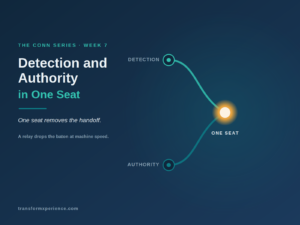
The conn is the named, accountable human who holds detection and authority in one seat, and who runs the operating model against drift.
Why Clinical Models Drift
A clinical AI tool is validated at a moment in time, against a patient population, a documentation practice, and an EHR configuration as they stood that day. None of those hold still.
- The patient mix shifts with the season, a new service line, or a change in referral patterns.
- Documentation practice changes when a template is rebuilt, an order set is revised, or a new group of clinicians joins.
- The EHR itself changes with upgrades, interface changes, and local builds.
- The vendor updates the model on its own release schedule.
Each change can move the inputs the model depends on. The model keeps running, and its performance in your setting can drift away from the performance you validated, with no error message and no red light on a dashboard.
Where Accountability Meets Across Functions
Ask who answers for a clinical AI tool in production and the answer usually spans several functions. Clinical informatics configures it. IT runs the infrastructure. Quality and patient safety review events. The department chair owns the clinical workflow it supports. The vendor owns the algorithm. Each may be fully accountable for its own responsibility.
Many health systems now have an AI committee that approves tools before use, consistent with the guidance’s call for a formal governance structure. The additional question is who is accountable for each tool’s performance in this setting between reviews, and for coordinating a response across those functions when it changes. The guidance makes a related point: monitoring responsibility should be discussed as part of third-party procurement and contracting.
The vendor owns the algorithm. The hospital owns the use. Someone has to own the distance between them.
What the Conn Holds in a Clinical Setting
In a clinical setting, the conn is the seat accountable for detecting material drift in a clinical AI tool’s performance in this setting and for coordinating the response. Three boundaries make that safe.
The conn governs the tool, not the care. The seat does not override a clinician’s judgment about a patient; the clinician remains the decision-maker at the bedside. For a clinical AI tool, the conn may appropriately sit with a clinical leader, such as a CMIO or service-line medical director, depending on the tool’s use and the organization’s delegated authority. The seat remains accountable for coordinating the response, while clinical decisions stay with appropriately authorized clinical leaders.
The fallback is approved and practiced. Hospitals already plan and practice for EHR downtime: the paper forms, the manual workflows, the communication plan. The conn applies the same discipline to AI tools. Before a tool goes live, clinical leadership approves the workflow without it and the conditions for moving to that workflow, and the units practice it, so a pause is a planned step, not an improvised one.
Authority is defined, not unlimited. The conn is accountable for the integrated response and holds pre-agreed authority to invoke defined actions: pause, contain, restore a known-good state, or escalate. The teams responsible for the affected systems execute the technical changes within their assigned authority. The conn remains accountable for confirming that the response worked before normal operation resumes. In a clinical setting, that authority is established within clinical boundaries: the trigger conditions, the containment actions, and the fallback are approved by clinical, quality, and compliance leaders before deployment. Anything beyond them goes to the people who hold that authority.
An Illustrative Case
An inpatient deterioration alert performs well at validation. Months later, a nursing documentation template is rebuilt, and one of the inputs the model reads is now charted differently. The alert begins firing more often. Nurses, already managing heavy alert volume, start dismissing more of them. Each function sees a piece: informatics sees the template change, quality sees a rising dismissal rate in a monthly report, nursing leadership hears frustration on the units.
With a conn in place, the response was decided before the tool went live. Clinical leadership approved the alert-rate and dismissal-rate thresholds, the containment step, and the fallback workflow as part of deployment. When the thresholds are crossed, the conn invokes that approved response within its delegated authority: the alert is paused and the unit moves to the practiced fallback. Informatics reverts or remaps the template change. The conn coordinates the correction with informatics, nursing, and the vendor, and records what was seen, what was decided, and when.
Technical recovery is not the end. Before the alert returns to the workflow, the appropriate clinical and technical owners confirm that it is performing as validated, and clinical leadership confirms that it is appropriate to resume. That record is the evidence the seat acted with discipline, and the evidence a surveyor or a board may ask to see.
Where TransformXperience Fits
TransformXperience works on the accountability that crosses clinical operations, technology, quality, and vendors. For clinical AI, that means defining which tools are material enough to need a seat, who holds each one, the authority it carries within clinical boundaries, the fallback it can invoke, and how the signal reaches it, then implementing those connections and remaining accountable for the parts working together until your team takes over and runs it. It does not replace the vendor, clinical leadership, or the organization’s established technical and clinical authorities.
An AI committee sets policy and approves tools. A vendor monitors its own model. A chief AI officer may be the right accountable leader for certain decisions, but the title does not automatically connect that leader to the signals, decision rights, and response capabilities a clinical tool requires. Those connections must be established deliberately.
This is work I know from the inside. In my career, I directed a portfolio of more than $20 million in cloud, data, and AI and machine learning initiatives for one of the nation’s largest integrated health systems, serving as the liaison between IT and the business. Earlier, I led a team of more than 30 through a security and compliance transformation for a major health payer that delivered 35 percent cost savings and a 22 percent process improvement. The seam between the people who build healthcare technology and the people who depend on it is where much of that work took place.
Who Answers for Your Clinical AI?
Pick the AI tool in your organization that touches patient care most directly. Who would see its performance drift first, and how long after it began? Could the responsible seat invoke an approved pause and move the unit to a practiced fallback today? If the answer is a list of departments, the next step is establishing accountability for the integrated result across them.
Find the Seat Behind Your Clinical AI
Start with a free 30-minute conversation. We will talk through your clinical AI tools, where drift could emerge, who would see it, who holds the authority to respond within your clinical boundaries, and whether there is a fit.
For a self-check first, the Healthcare IT Readiness Checklist on the Insights hub scores 20 areas across strategy, technology, capability, and operations.