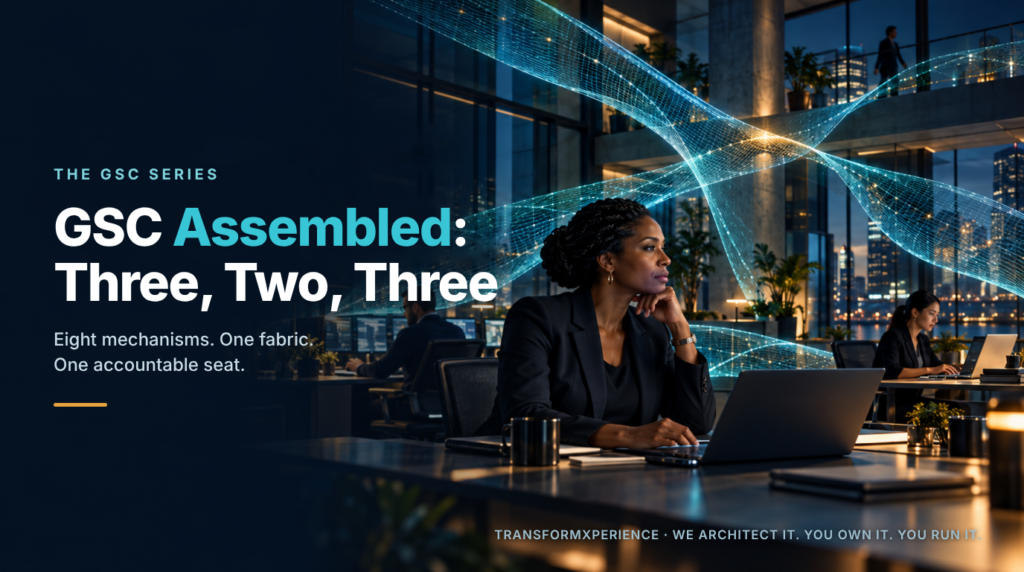
Eight mechanisms, one fabric, one seat. The whole structure in one view.
GSC is easiest to understand one block at a time, and most useful all at once. This post puts all eight mechanisms in one view, shows how they work as a single structure, and answers the question leaders ask once they see the whole: how does this relate to the operating model we already run?
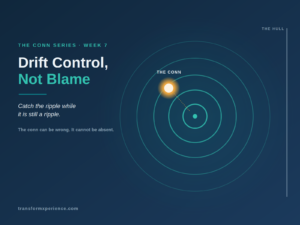
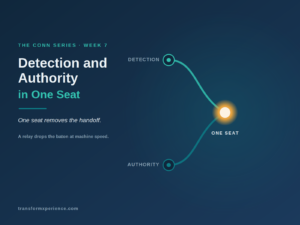
GSC stands for Governance, Security, and Control: eight mechanisms in three complementary blocks. All of them are read by one accountable seat, which we call the conn. The conn is the named, accountable human who holds detection and authority in one seat, and who runs the operating model against drift.
One word on terms. When we say the running model, we mean the live AI system: its model, its data, its tools and workflow, the decisions it makes, and the human handoffs around it in production. Not only the underlying model. The whole system as it runs.
Three Responsibilities, One Running System
Each block carries one responsibility for the running model.
- Governance: what the system is authorized to do. Risk management, cost controls, and compliance, read against the running system rather than filed once a year.
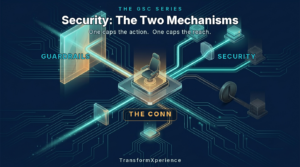
- Security: what the system must be prevented from doing or accessing. Guardrails and security. The block shares its name with one of its two mechanisms, so hold the two apart: the Security block covers the operational constraints on the system, and the security mechanism is the access and identity control inside it.
- Control: how behavior is observed, decisions recorded, and deviations addressed. Observability, audit logs, and rollbacks and overrides.
These are not three stages, and they are not three departments. All three operate continuously, before, during, and after every automated decision. Governance sets the terms and keeps reading the system against them. Security holds its limits in the flow of the work. Control watches, records, and restores.
Take any one away and the other two lose their footing. Governance without Control is a standard no one can see being missed. Security without Governance is a brake with no agreed limit. Control without Security sees the problem and records it after it has already run.
The Eight Mechanisms in One View
Each mechanism answers one question about the running model. Read down the right-hand column and you have the questions the conn has to be able to answer at any moment.
Block | Mechanism | The question it answers |
Governance | Risk management | What could this harm now, and is that exposure still acceptable? |
Governance | Cost controls | Is the system spending only what it was authorized to spend? |
Governance | Compliance | Is it inside the rules that apply, judged by what it does today? |
Security | Guardrails | What must it never do, enforced in the flow of the work? |
Security | Security | What must it never reach, and can access be narrowed or revoked in time? |
Control | Observability | Can we detect material drift within the window that matters? |
Control | Audit logs | Can we reconstruct what happened, who decided, and who acted? |
Control | Rollbacks and overrides | Can we contain the issue, restore approved operation, and verify recovery? |
One Event, Read Together
Here is why the eight belong to one fabric and one seat. Picture an illustrative case: a pricing agent that applies discounts to renewal quotes. A segmentation update upstream reclassifies more customers as at risk of leaving, and the agent starts discounting deeper and more often.
Not every mechanism registers this event, and none should be forced to. These are the ones that do.
- Risk management reads rising margin exposure on a book of business.
- Compliance reads discount patterns that now differ by segment in a way the pricing policy did not approve.
- Guardrails hold every discount at the approved ceiling, so the deepest offers stop at the line.
- Observability shows the discount rate drifting from the validated baseline, inside the window the conn set.
- Rollbacks and overrides contain it. Under pre-agreed authority, the conn pauses automatic discounting above a defined threshold and routes those quotes for human review, while the pricing team reverts or corrects the segmentation update.
- Audit logs record the update, the signals, each decision, and who executed what.
In this scenario, cost controls and security show no unusual activity, and that is the point. They keep enforcing their boundaries while the event runs. The conn confirms discount rates are back on baseline before automatic discounting resumes in full.
In our experience, readings like these land in four or five functions, on four or five clocks: finance at month end, compliance at the quarterly review, risk at the next register update. Each sees a slice, late. GSC defines the eight mechanisms as one fabric, so one accountable seat can read them together. The conn is accountable for the integrated response and holds pre-agreed authority to invoke defined actions: pause, contain, restore a known-good state, or escalate. The teams responsible for the affected systems execute the technical changes within their assigned authority. The conn remains accountable for confirming that the response worked before normal operation resumes.
Eight controls in eight functions is a collection. Eight mechanisms read by one seat is a control structure.
How GSC Relates to the Operating Model
GSC does not sit above or below the operating model. It runs through it. The Velocity Governance Framework™ moves the work. The AGE Framework™, our Adaptive Governance Engine, keeps the work trustworthy as it scales. Together, they serve as operating engines. GSC is the load-bearing fabric alongside them, providing continuity as platforms, use cases, and teams change. The conn is the accountable seat that reads the fabric and answers for the integrated response.
That relationship matters because platforms, use cases, and teams will keep changing. The engines move the work and keep it trustworthy. The fabric holds steady while they do, and the conn answers for it.
Where TransformXperience Fits
TransformXperience defines GSC inside the systems and functions you already run, implements it, and stays accountable for the parts working together until your team takes over and runs it.
GSC is not a committee. A committee sets policy and reviews performance on a calendar that drift does not keep. It is not a new platform. Platforms are powerful appliances that plug into the fabric; they are not the fabric. And it is not a new department. Most of the eight mechanisms exist in part today, scattered across functions. The work is defining them as one structure, implementing the connections, and putting one accountable seat on the other end.
Naming the conn is the first move. Connecting the conn to GSC is the second. The question that follows is whether the seat is real: whether it can see and act, or only carries a name.
See the Whole Structure Against Your Own Operation
Take one automation that can move your business and ask the eight questions in the table above. Note which ones your team can answer today, which take a meeting, and which no one owns. If the gaps outnumber the answers, start with a free 30-minute conversation. We will talk through where your running systems are exposed, who would see it, who could act on it, and whether there is a fit.