See it. Prove it. Put it back, and confirm it held. The block that closes the loop.
Ask three questions about an AI system you run in production. What is it doing right now? What did it do last Tuesday, who decided what to do about it, and who acted? If it went wrong this afternoon, how fast could you contain it, put it back the way it was approved, and know that it held?
If each answer needs a meeting, a ticket, and a call to the vendor, the system is running ahead of your ability to answer for it.
Every AI system in production runs on decisions someone made before launch: what it may do, what it must never do or touch, and how anyone would know if it stopped behaving as intended. GSC is how TransformXperience organizes those decisions. It stands for Governance, Security, and Control: eight mechanisms in three complementary blocks. Governance sets what the system is authorized to do. Security sets what it must be prevented from doing or accessing. The block shares its name with one of its two mechanisms: the Security block holds guardrails and security, and it covers the operational constraints on the system, not only cybersecurity. Control covers how behavior is observed, how decisions are recorded, and how deviations are addressed.
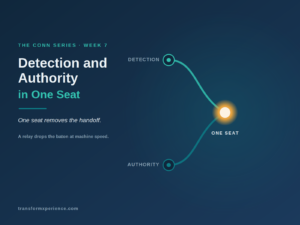
All three blocks are read by one accountable seat, which we call the conn. The conn is the named, accountable human who holds detection and authority in one seat, and who runs the operating model against drift.
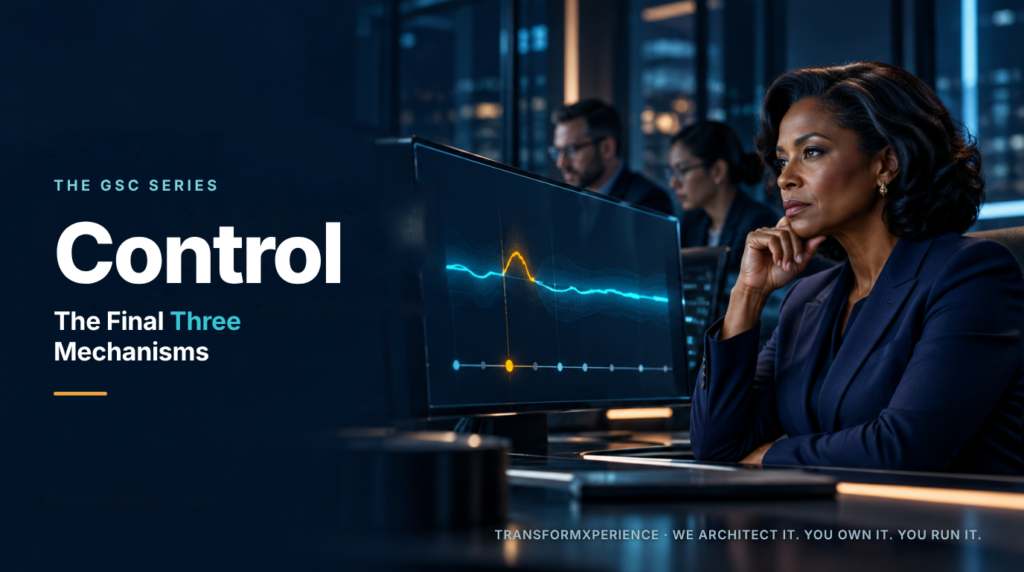
This post covers the third block. Control is three mechanisms: observability, audit logs, and rollbacks and overrides.
One word on terms. When we say the running model, we mean the live AI system: its model, its data, its tools and workflow, the decisions it makes, and the human handoffs around it in production. Not only the underlying model. The whole system as it runs.
One. Observability: What the Model Is Doing Now
Monitoring often stops at health. Uptime, latency, volume, a green tile on a dashboard. Those readings tell you the system is running. They do not tell you whether it is still doing what you decided it should do.
Observability, as GSC uses the term, goes beyond system health to behavior measured against what you decided. Is the model still applying the rule you approved? Is the share of cases it routes to exceptions shifting? Are its outputs moving away from the pattern you validated before launch? Health tells you the engine is on. Behavior tells you whether the system is still on course.
Most of that watching should be instrumented. The conn does not stare at screens. The conn owns the signal: what counts as material drift, where the threshold sits, and what happens the moment it trips. A system can be fully monitored and still unobserved, if no seat owns what the monitoring means.
Two. Audit Logs: What Happened, Who Decided, Who Acted
When something goes wrong, the first question is what happened. The next two are who decided, and who acted. In our experience, those answers are often reconstructed after the fact, from email threads, meeting notes, and a system log that recorded the transaction but not the decisions around it.
As a GSC mechanism, the audit log records the decision trail, not only the activity. What the model did. Which rule and which version it applied. What signal reached the conn, and when. What the conn decided: pause, contain, restore a known-good state, escalate, or let it run. And which team executed each action. The record of the human calls matters as much as the record of the machine’s.
The record does two jobs. First, it gives regulators, boards, and customers a traceable account of what happened, what was decided, and who acted, reducing the need to reconstruct the response after the fact. Second, it is what makes the phrase “the conn can be wrong” safe to say. A seat judged on discipline needs evidence of the discipline: the trigger was met, the response was proportionate, it came inside the window, and it was reviewed. The audit log is that evidence.
Three. Rollbacks and Overrides: Putting It Back
Seeing drift and proving it are not enough if you cannot undo it. A rollback returns the affected system component to a validated, known-good version, rule, configuration, or compatible data interface. An override lets a human decision take precedence over the model’s output in a defined case, on the record.
Both have to be ready before they are needed. A rollback no one has tested is a hope. An override that needs three approvals in the moment is a meeting. As a GSC mechanism, the known-good state is defined in advance and the path back is rehearsed.
This is where the conn’s authority becomes concrete. The conn is accountable for the integrated response and holds pre-agreed authority to invoke defined actions: pause, contain, restore a known-good state, or escalate. The teams responsible for the affected systems execute the technical changes within their assigned authority. The conn remains accountable for confirming that the response worked before normal operation resumes.
That last step matters. Invoking a rollback is not the same as verifying recovery.
A system can be fully monitored and still unobserved, if no seat owns what the monitoring means.
Closing the Loop
Picture an illustrative case. A claims-triage agent starts sending a growing share of claims down the fast-pay path after an upstream data feed changes its format. Nothing in the agent changed. Its input did.
Observability catches the shift against the validated baseline, inside the window the conn set. Under pre-agreed authority, the conn suspends the fast-pay path, routes new claims to manual review, and calls the data owner to roll back or remap the feed change. The data team executes the fix. The conn confirms the routing pattern is back on baseline before reopening the fast-pay path. The audit log records the signal, each decision, and who executed what. At the next review, the team examines whether the threshold should have triggered earlier and adjusts it if the evidence supports the change.
See it. Prove it. Put it back, and confirm it held. Then learn from it. That is the loop, and it is why Control is three mechanisms, not one.
Where TransformXperience Fits
TransformXperience defines the three Control mechanisms as one loop, implements it inside the systems you already run, and stays accountable for the parts working together until your team takes over and runs it.
Many organizations already own pieces of this loop. Monitoring may sit with operations, logs with IT, and rollback with whoever deployed the last release, each on its own clock. A monitoring platform watches, often well, but it cannot answer for what it sees. Incident management responds to detected events and disruptions. Control also addresses emerging drift before it becomes an incident, and leaves a record that the response was sound.
That completes the three, two, three. Governance sets what the running model is authorized to do. Security constrains what it must not do or reach. Control closes the loop. Eight mechanisms, one fabric, one seat.
Can You Answer the Three Questions?
Pick the automation that matters most to your operation and ask the three questions this post opened with. If the answers live in three functions on three clocks, start with a free 30-minute conversation. We will talk through where drift could emerge in your operation, who would see it, who could act on it, and whether there is a fit.