You named the person on the hook for the AI. Now ask what they are holding.
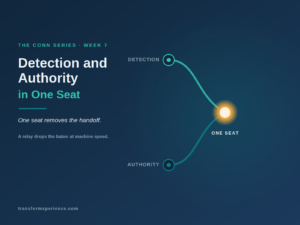
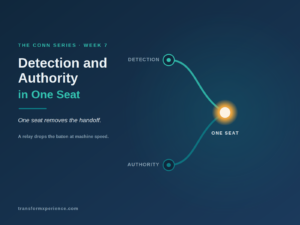
Every serious AI conversation ends in the same place. Someone has to be accountable for the system when it drifts. We call that person the conn: the named, accountable human who holds detection and authority in one seat, and who runs the operating model against drift. The conn is the assigned control owner for a live AI system, not a new job title.
A name on a seat with nothing in its hands is not control. Accountability without instruments is a person who can see the problem and do nothing about it. Name a conn and give the seat no structure to work with, and you have named a witness, not a controller.
The conn holds a structure. We call it GSC.
| A named seat with nothing in its hands is a witness, not a controller. |
What GSC is
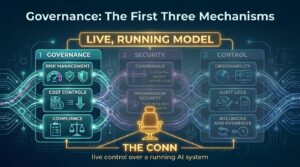
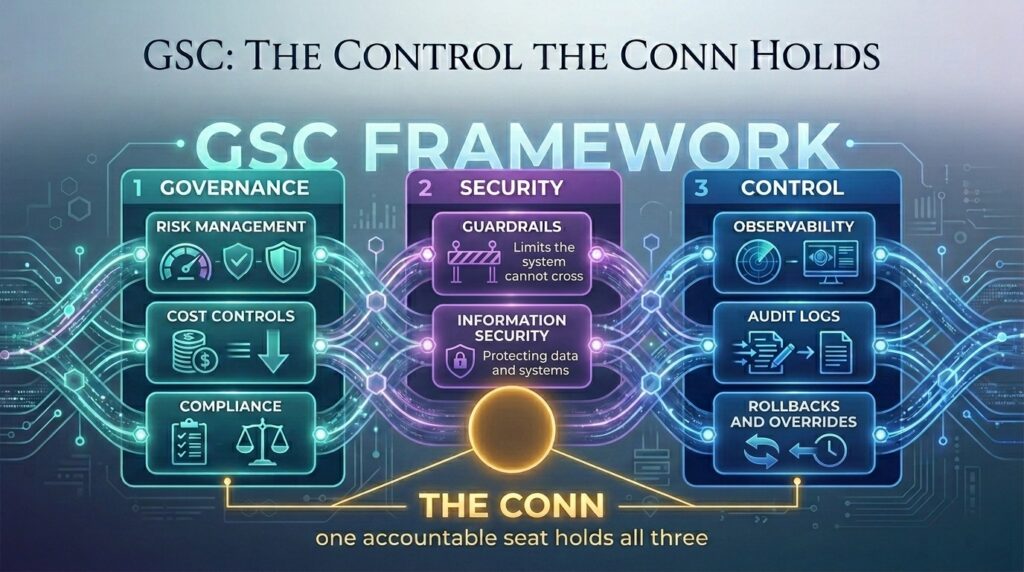
GSC stands for Governance, Security, and Control. It is a structure of eight mechanisms, grouped three, two, and three. Three Governance mechanisms. Two Security mechanisms. Three Control mechanisms.
One word on terms. When we say the running model, we mean the live AI system: its model, its data, its tools and workflow, the decisions it makes, and the human handoffs around it in production. Not only the underlying model. The whole system as it runs.
GSC is not a committee, and it is not a tier stacked on top of your operating model. It is the continuous fabric that runs through the model and bears the load while everything else moves. Your platforms change. Your use cases change. Your teams change. GSC is the part that does not, because its value is that it holds steady while the rest of the system runs at speed.
TXP defines those eight mechanisms and puts them in one seat, the conn, so the person accountable for the model is the person operating the controls. A policy binder describes control. A steering committee convenes control. A monitoring platform watches. None of them holds it. The conn does, and GSC is what the conn holds.
Three blocks, one fabric
The eight mechanisms fall into three blocks.
Governance is the first three: risk management, cost controls, and compliance. It is how the conn keeps the running model honest against the model you designed. Risk, cost, and compliance, read live, not filed once a year. This is the block the series opens on.
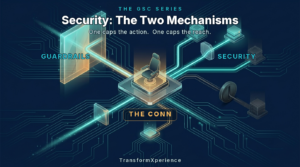
Security is the middle two: guardrails and security. Guardrails are the limits the model cannot cross, enforced in the flow of the work. Security is the access, identity, and information-security controls around the model and the data it touches. Together they are the brake, not the bureaucracy: what lets the conn stop or constrain the system when keeping it honest is not enough.
Control is the final three: observability, audit logs, and rollbacks and overrides. The conn can see what the system is doing, prove what happened, and return it to a known-good state when it goes wrong. It closes the loop.
Three, then two, then three. Eight mechanisms, one fabric, one seat.
Why one seat
GSC groups the mechanisms this way for the same reason it puts them in one seat. Drift does not respect your org chart. A single drift event usually shows up across more than one block at the same time, and in most organizations those blocks live in separate functions on separate clocks.
Picture an agent that starts routing exceptions outside the approved path. Risk sees exposure. Finance sees cost. Compliance sees a gap. Security sees data reaching further than it should. Four signals, four functions, four clocks, and the system keeps running while each waits for its own escalation. Each sees a piece, late, and no one holds the connection. The drift hides in the seams between them.
GSC removes the seams by design. It does not merge your departments. It defines the eight mechanisms as one fabric and gives one accountable seat the standing to read them together and act. TXP builds that structure so the conn reads the whole field, not one function’s slice of it.
What changes
With GSC, the conn is not a name in a document who gets briefed after the incident. The conn is a seat with instruments, reading the running model continuously, with the authority to act inside the window where drift is still small. Act means something concrete here: pause the workflow, tighten a guardrail, revert to a known-good state, escalate to a human decision. Defined authority, not unlimited, and not improvised in the moment. That is the difference between naming accountability and equipping it.
Naming the conn is the first move. Handing the conn the structure is the second. This series walks the eight mechanisms one block at a time, starting with the first three.
| The gap GSC closes. If you have named AI owners but never defined what they can see, decide, stop, or restore, that is the operating-model gap this framework is built to close. The Transformation Pulse carries the weekly through-line, from the operating model to the conn who runs it. Subscribe to follow the full GSC build. Resource: the Velocity Governance Framework White Paper is available from the Insights hub. |