Introduction
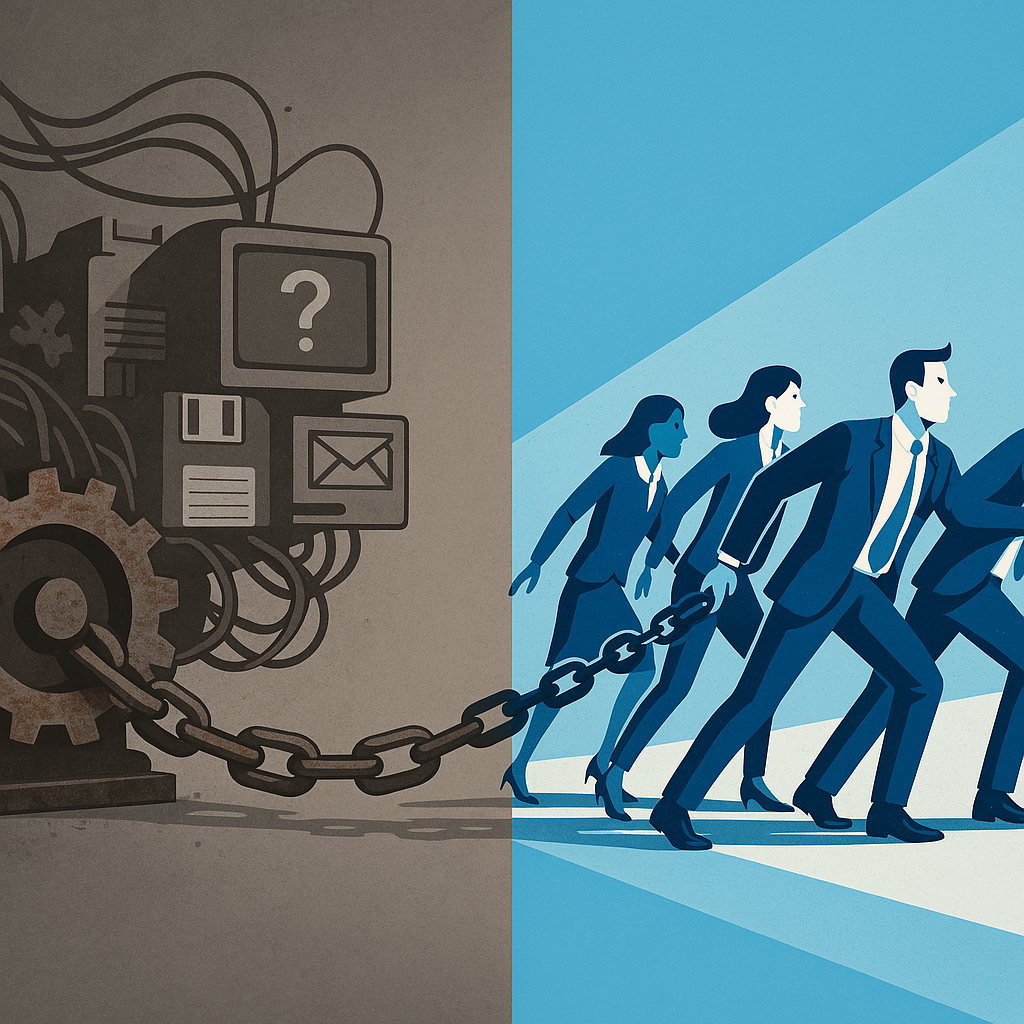
In today’s hyper-competitive digital landscape, innovation is king, and agility is paramount. Yet, for many enterprises, this pursuit of speed and transformation often encounters a formidable barrier: the legacy IT backbone. Outdated systems, rigid architectures, and aging infrastructure can act like digital anchors, dragging down progress, stifling innovation, and consuming disproportionate resources.
For CIOs and IT leaders, the question isn’t whether to modernize, but how to do so strategically, efficiently, and with minimal disruption. It’s about building an IT foundation that not only supports current operations but also actively propels future growth.
The urgency has never been greater. With regulatory compliance deadlines tightening (such as upcoming data privacy regulations), competitors gaining market share through digital advantages, and emerging technologies like AI/ML becoming business-critical, organizations face a narrow window to modernize before falling irreversibly behind.
The Weight of the Past: Why Legacy Systems Are Holding You Back
Clinging to outdated legacy systems carries significant, often hidden, costs and risks:
- Skyrocketing Maintenance Costs: Maintaining archaic systems becomes increasingly expensive as skilled personnel dwindle and parts or support become obsolete. Industry research indicates that organizations typically allocate 60-80% of their IT budget to maintaining legacy systems, leaving only 20-40% for innovation initiatives.
- Lack of Agility: Legacy architectures are notoriously inflexible, making it difficult to adapt to new business requirements, integrate emerging technologies (like AI/ML), or respond quickly to market shifts. Companies with modernized IT infrastructures can deploy new capabilities five times faster than those relying on legacy systems.
- Security Vulnerabilities: Older systems often lack the robust security protocols needed to defend against modern cyber threats, increasing the risk of data breaches and compliance failures (impacting data integrity and DLP efforts). Legacy system vulnerabilities account for 60% of successful cyberattacks against enterprises.
- Stifled Innovation: The inability to integrate with modern APIs or leverage cloud-native services means your organization falls behind competitors in speed, efficiency, and customer experience.
- Talent Attrition: Younger, technically proficient talent is often disinclined to work on outdated systems, making recruitment and retention difficult.
- Poor Data Utilization: Data trapped in disparate, legacy silos makes it challenging to achieve a unified view for analytics, leading to missed insights and inefficient decision-making. Organizations with modernized data architectures report 23% faster decision-making and 19% increase in revenue.
The Blueprint for Modernization: Strategies for a Future-Ready IT Backbone
Modernizing your IT backbone is a strategic journey, not a single project. It requires a clear vision, meticulous planning, and expert execution. Here are key strategies:
1. Strategic Assessment & Prioritization
Action: Begin with a comprehensive assessment of your current IT landscape. Identify critical applications, data dependencies, technical debt hotspots, and business value.
Guidance: Prioritize modernization efforts based on business impact, risk reduction (e.g., security vulnerabilities), and readiness for migration. Not everything needs to be replaced at once; some systems can be optimized, others retired, and critical ones re-platformed.
2. Embracing the Cloud: The Foundation of Modern IT
Action: The strategic adoption of cloud platforms, such as Azure Cloud solutions, is often the cornerstone of modernization. This involves migrating infrastructure (IaaS), platforms (PaaS), and applications (SaaS).
Guidance: Cloud offers scalability, flexibility, reduced operational overhead, and access to cutting-edge services. Specific Azure services, such as Azure Arc, enable hybrid management, Azure Synapse provides advanced analytics capabilities, and Azure Security Center delivers comprehensive threat protection. The cloud shifts capital expenditure to operational expenditure, enabling agility while typically reducing total cost of ownership by 20-30%.
3. Application Modernization Pathways
Action: For individual applications, choose the right modernization strategy:
- Re-hosting (Lift & Shift): Moving applications to the cloud with minimal changes.
- Re-platforming: Migrating to the cloud, optimizing for cloud capabilities (e.g., managed databases).
- Re-factoring/Re-architecting: Rebuilding parts of applications to take full advantage of cloud-native services (microservices, containers).
- Replace: Switching to a new SaaS solution (e.g., new ERP).
Guidance: The choice depends on complexity, cost, business criticality, and desired future state. For risk-averse organizations, a phased hybrid approach often works best—maintaining critical systems on-premises while gradually migrating less essential workloads to build confidence and expertise.
4. Building Scalable & Resilient Infrastructure
Action: Focus on designing infrastructure that can automatically scale up or down based on demand, ensuring high availability and disaster recovery capabilities.
Guidance: This involves leveraging cloud auto-scaling, load balancing, multi-region deployments, and robust backup strategies to ensure optimal performance and reliability. Azure’s global infrastructure and services, such as Azure Site Recovery, provide enterprise-grade resilience. Modernized infrastructure typically achieves 99.9% uptime or higher, compared to 95-98% for legacy systems.
5. Data Modernization & Integration
Action: Modernize your data architecture. This includes migrating legacy databases to cloud-native solutions, implementing data lakes, and establishing robust data governance frameworks (e.g., MDM, data quality).
Guidance: Clean, integrated, and accessible data is crucial for powering modern analytics and AI, transforming raw information into actionable insights. Organizations with modernized data platforms report 65% faster time-to-insight and 40% improvement in data quality.
TransformXperience’s Approach to Modernizing Your Technology Platforms
At TransformXperience, we don’t just advise; we partner with you to execute your modernization journey from vision to sustainable reality. Our approach is characterized by:
- Strategic Roadmapping: We work with your C-suite to define a clear, phased modernization roadmap that aligns directly with your business goals and minimizes disruption. Our roadmaps typically deliver measurable ROI within 6-12 months.
- Cloud Enablement Expertise: Our deep experience with Azure Cloud solutions and other leading cloud providers ensures seamless migration, optimization, and the effective utilization of cloud-native services, including Azure Arc for hybrid management, Azure Synapse for analytics, and Azure Security Center for comprehensive protection.
- Program Management Excellence: We leverage our expertise in managing high-risk, multi-million dollar programs to oversee complex migrations, ensuring projects are delivered on time, within budget, and with robust governance. We can establish or rebuild IT PMO structures to support this transformation.
- Data & Application Modernization: We provide comprehensive solutions for data migration, application re-platforming, and building resilient data architectures that are secure and compliant.
- Change Management & Adoption: We understand that technology is only part of the equation. We help manage organizational change, overcome resistance, and ensure successful adoption by your teams.
Take the Next Step: Your Modernization Assessment
Ready to move beyond legacy constraints? Here’s how to begin:
Immediate Action: Request our complimentary IT Modernization Readiness Assessment—a comprehensive evaluation that identifies your highest-impact modernization opportunities and quantifies potential ROI.
Strategic Planning: Schedule an executive briefing with our modernization experts to develop a customized roadmap aligned with your business objectives and risk tolerance.
Pilot Program: Consider starting with a low-risk, high-visibility pilot project that demonstrates the value of modernization while building organizational confidence.
Conclusion
The decision to move “Beyond Legacy” is a commitment to your organization’s future. It’s about shedding the weight of outdated systems to embrace the agility, innovation, and scalability required to thrive in the digital age. By strategically migrating from legacy systems, embracing the power of cloud solutions like Azure, and building a truly scalable and resilient IT backbone, you are not just upgrading technology—you are enabling fundamental digital transformation that drives sustained growth and competitive advantage.
With market pressures intensifying and digital transformation becoming a prerequisite for competitive survival, organizations that act decisively on modernization will capture tomorrow’s opportunities, while those that delay risk being left behind.
Partner with TransformXperience to transform your IT backbone from a constraint into your most powerful engine for future success.
Ready to modernize your IT backbone? Schedule a consultation with TransformXperience today to begin your complimentary modernization assessment and take the first step toward your digital future.